This work is a site where the patriarchal impulse to hierarchical order and the wild autonomy of nature remain locked in a slow, unresolved dialectic.
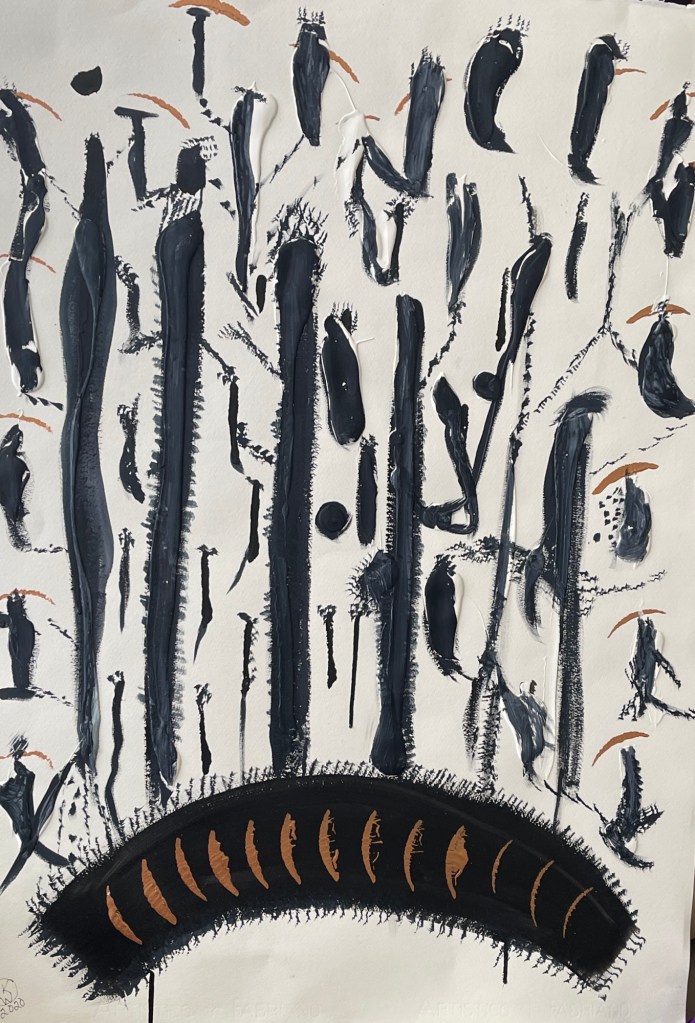
Hierarchy and domination Over the Natural Threshold
From David Hinton’s perspective, he might note that this painting inhabits the paradox of wu wei: (effortless action) the strokes feel inevitable, unforced, yet each arrival on the paper bears the weight of deliberate presence.
From a Taoist perspective, the painting can be read as a dynamic dance between emptiness and fullness, stillness and movement.
• Vertical black strokes: These could represent bamboo, rain, or streams of qi — each unique part of the same flow. Taoism emphasizes how each form arises from the same source (the Dao) and dissolves back into it.
• Negative space (beige background): In Taoism, emptiness isn’t absence — it’s the fertile void from which all things emerge. The surrounding blankness here is as important as the strokes themselves.
• The arc at the bottom: This semicircular form, edged with copper-red crescents, might be the “earth” or “root” from which the vertical energies rise. In Taoist cosmology, it mirrors the relationship between yin (ground, receptivity) and yang (upright movement). It can be understood as the dark enigma.
Another spiritual symbol is the Jewish mystical, Tree of Life iconography ⸻ it points out the irrefutable significance of the INTERDEPENDENCE OF FLORA, FAUNA and HUMAN ACTIVITY.
PATRIARCHAL DOMINATION HAS OVERWROUGHT Nature. NATURE NEEDS to have more voice for ecological balance.
Hinton often frames Chinese thought as a way of dwelling in the world’s texture rather than standing apart from it. Through his lens:
• The brushstrokes aren’t “objects” but events — brief appearances of ink in the endless transformation of the paper’s space.
• The texture and fraying of the edges are like mountains eroded by time; even the seeming “figures” dissolve into the field, reminding us that there is no fixed boundary between “person” and “landscape.” The Tang LANDSCAPE Poets and Artists believed they were just expressing their internal mind.
The copper-red arcs suggest seasonal cycles, perhaps autumn leaves or setting suns — moments in a world where time is cyclical rather than linear.
Hinton might say this is not a painting of something, but a moment in the cosmos-being-itself.
In any case, the lower arched form, densely bristled, acts as a threshold—perhaps the ridge of a hill, perhaps the lip of a vessel—over which the entire drama of rising and falling forms unfolds.
In Adorno’s dialectical frame, the piece resists being absorbed into either pure abstraction or pure figuration. The black forms refuse to resolve into definitive shapes—human, vegetal, animal, or architectural—and in this refusal, the artwork resists the demand for comfort. The verticals carry a disciplinary order, almost a regiment, yet their frayed edges and uneven rhythm suggest a different order. The copper-red arcs may suggest the mechanized repetition of scything—a ritual of domination over nature—but their fragmentary placement breaks the cycle. For Adorno, this tension—between the serene verticality and hierarchy, contrasted with the tree of life natural forms—is where the artwork gains its truth content: it refuses reconciliation, keeping the contradiction alive.
Through Adorno’s lens, this isn’t a tranquil meditation (as Taoism might suggest) but a confrontation: the truth of the painting lies in its tensions, its refusal to smooth over contradiction, chaos, fission, fracture, … pointing to the tension between the hierarchy’s domination and the chaos of nature.
Together, Hinton’s cosmological Wu-Wei and Adorno’s unresolved dialectic illuminate the work as a site where the patriarchal impulse to hierarchical order and the wild autonomy of nature remain locked in a slow, unresolved dance. The result is a poised, in-between and unresolved relationship, still deciding whether it will become grove or battlefield.
 Art by Kate W