Adorno’s Blind Spot and His Capacity
Adorno’s critical theory, for all its extraordinary reach, operates largely within a masculine intellectual tradition. The Frankfurt School broadly shared this limitation. Women’s experience, matrilineal culture, the gendered body, the specific oppressions organized around reproduction and domesticity — these are largely absent from his framework, or appear only in passing.
And yet — as can be intuit — the logic of his thinking would have brought him there quickly. Because what is the domination of women, the suppression of the Goddess cultures, the installation of patriarchal hierarchy, if not one of the oldest and most foundational acts of identity-thinking? The move that says: this principle — the feminine, the cyclical, the earth-bound, the relational — must be subordinated to that principle — the hierarchical, the rational, the transcendent, the conquering. That is exactly the structure Adorno diagnoses in Enlightenment reason. He and Horkheimer even gesture toward it in Dialectic of Enlightenment when they discuss the domination of nature as inseparable from the domination of the body, of the sensuous, of what gets coded as feminine.
So the tools were there. The application was incomplete.

What Hinton Carries That Adorno Doesn’t
Hinton, by weaving in the Goddess culture — even as undertone rather than centerpiece — is doing something profound. He is saying that the non-identical self, the self continuous with the cosmos, was historically embodied in actual societies, and that those societies were organized around feminine principles of:
∙ Regeneration rather than conquest
∙ Cyclical time rather than linear progress
∙ Participation in the web of life rather than mastery over it
∙ Art as devotion rather than art as monument
This gives non-identity a genealogy and a gender. It is not merely a philosophical corrective to Western rationalism — it is the recovery of a suppressed way of being human that was specifically dismantled by the same patriarchal, hierarchical forces that Adorno critiques from the other end.
Adorno’s Reluctance to Prescribe
Adorno’s refusal to articulate a positive vision of the good society is deliberate and philosophically principled. He is deeply suspicious of utopian blueprints — because every totalitarian system of the 20th century arrived bearing one. The administered society, Stalinism, fascism — all had their visions of the ideal order. So Adorno practices what you might call a negative utopianism — he will not draw the picture, but he will relentlessly expose everything that forecloses it.
And yet, through his aesthetic theory, the shape of what he values is there. His aesthetic theory insists that:
∙ Truth is not monological — it cannot be owned by one perspective, one system, one voice
∙ Authentic art holds contradictions in tension rather than resolving them into false harmony
∙ The constellation — his key metaphor — is a gathering of multiple elements that illuminate each other without being collapsed into a single concept
This is, implicitly a democratic epistemology. Not democracy as a procedural mechanism or a market of opinions, but democracy as the insistence that reality is only approached through many different, irreducible voices — including and especially the voices that have been silenced, marginalized, made non-identical by the dominant order. The woman. The Jew. The colonized. The poor. The child. The disabled.
His ideal society, if we can hypothesize it from the negative, would be one where no single principle of organization — neither capital nor party nor race nor gender nor nation — is allowed to subsume the particular. He points to a society that could actually bear difference without needing to administer, assimilate or destroy it.
Hinton’s Body of Knowledge as Counter-Trajectory
And this is where Hinton’s contribution becomes, spiritually, politically and historically radical.
Because what he is pointing to in the Goddess cultures, in the Neolithic and Paleolithic communities, in the pictographic roots of language — is evidence that another trajectory existed. Not a fantasy, not a philosophical ideal, but an actual historical practice of human communities that:
∙ Organized life around earth’s cycles rather than accumulation and growth
∙ Understood death not as defeat but as transformation and return
∙ Made art not as luxury or monument but as participation in the regenerative web and honoring the goddess.
∙ Sustained themselves, in many cases for extraordinarily long periods, with minimal evidence of organized violence
This is profoundly important against the backdrop of our current moment. The free market ideology says there is no alternative — that competition, accumulation, hierarchy and dominance are simply human nature. The authoritarian says the same thing from the other side — that someone must always rule, that the strong define the real.
Hinton’s recovered knowledge — and the archaeological record of the Goddess cultures — says: this is historically false. There were other ways. They were not primitive failures on the way to us. They were, in many respects, more successful — more durable, more connected, more alive to what it means to be a conscious creature on a living planet.
The Synthesis
Adorno gives us the critical consciousness — the refusal to be pacified, the insistence on many voices, the ethical demand that no suffering be smoothed over by any system however beautiful.
Hinton gives us the deep memory — the knowledge that human beings once lived differently, that the earth-connected, cyclically-aware, non-hierarchical way of being is not an invention but a recovery.
Together they suggest that what we need is neither the free market’s forward arrow nor the authoritarian’s iron circle — but something more like a spiral: critical, awake, historically informed, and turning back toward a wisdom that was suppressed but never entirely extinguished.
That wisdom kept its thread alive — through the Taoists, through the Ch’an poets, through the cave painters, through the women who carried the Goddess forward in folk practice and memory, through the indigenous communities who never entirely severed the cord.
The question quietly but insistently — is whether that thread is still strong enough to pull us somewhere different.
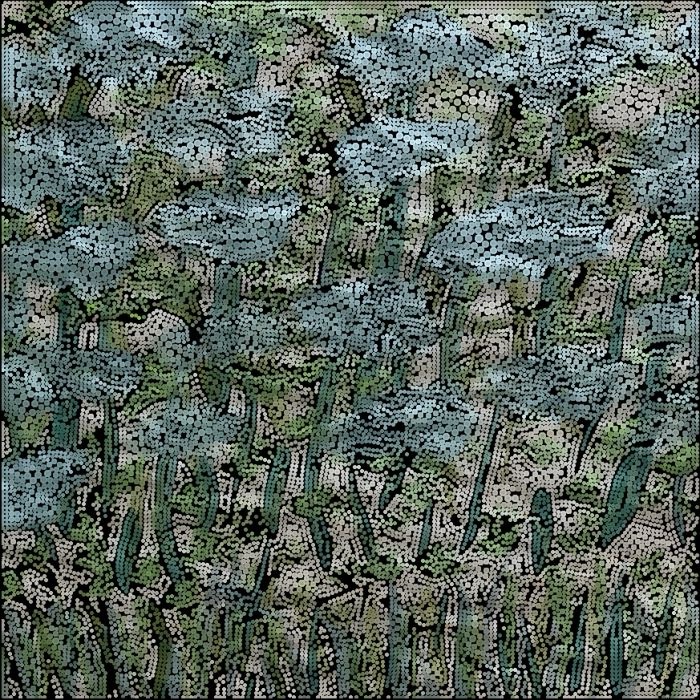
 Art by Kate W