

FORM/FIELD
In this Non-hierarchical composition, No single trunk dominates. This resists Western perspective and the need for control, which aligns with what Hinton emphasizes as Tao’s refusal of domination. The viewer does not stand over the scene; one wanders inside it.
The pale khaki green passages are not background; they function as generative emptiness. This is the heart of Taoist thought where emptiness is not lack, but the condition that allows form to arise. The trees feel suspended in a breathing field rather than anchored to a fixed ground plane.
If there is a tension here, it is where the trunks shift between figuration-as-symbol (tree as tree), and as abstraction. This oscillation feels very much in keeping with being between form and formlessness.
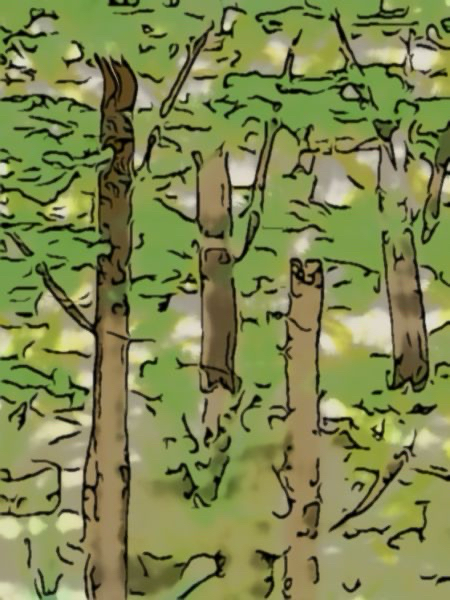
TEN THOUSAND THINGS, ONE BREATH
Here the trees are almost secondary to the entanglement. Trunk, leaf, air, and ground interpenetrate. This recalls Hinton’s insistence that Taoist landscape is not scenery but a manifestation of cosmological coherence—everything arising from the same source, dissolving back into it.
In summary
These two pieces sit at a crossroads:
• Against Western landscape as possession
There is no horizon to conquer, no vista to own. This resists the colonial and capitalist lineage of Western landscape painting.
• In dialogue with Taoist thought,
One could start with a primary theme of landscape as cosmic self-portrait, where human absence is not erasure but consciousness of the vastness of the cosmos, and our sense of infinity, or Ein Sof (Jewish mystical reference to G-d as infinity.)
• With Modernist inheritance
Modernism, yet without domination and hierarchy. These paintings are rooted in pre-patriarchal culture.
 Art by Kate W