Compare and contrast Theodore Adorno’s Aesthetic theories and Hans Hofmann’s theories of Push/pull and Spatial plasticity.
1. Through Theodor Adorno (Aesthetic Theory: Autonomy, Non-Identity, Negative Dialectics)
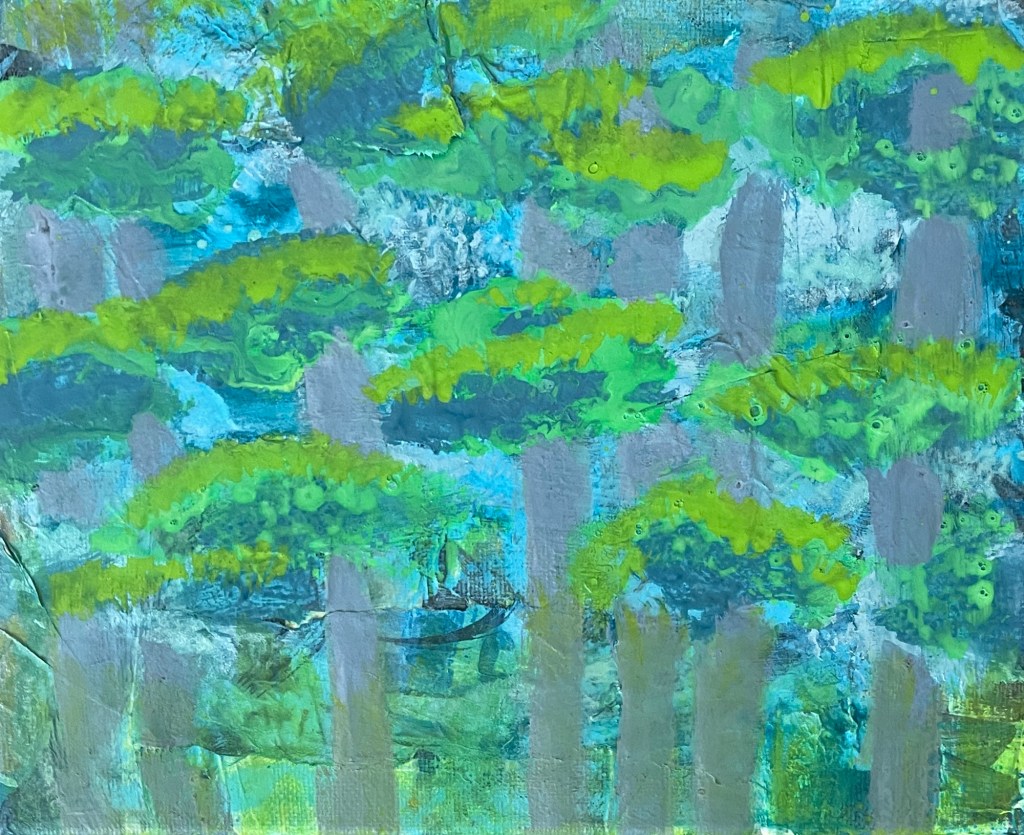
From an Adornian standpoint, the painting’s strength lies in its resistance to fixed representation. While it evokes landscape—aqueous blues, vegetal greens, vertical trunk-like strokes—it refuses a single viewpoint figuration. This tension between suggestion and withdrawal produces what Adorno would call non-identity: the work gestures toward nature yet resists in leading the viewer to consume this as an illusion of nature.
The layered application of paint—scraped, overlaid, partially obscured—embodies sedimentation. One sees traces of previous gestures not fully erased. This preservation of process aligns with Adorno’s idea that authentic artworks reveal their own constructedness rather than presenting seamless illusion. The painting does not resolve into harmony; it maintains the tension between:
• Organic color fields (greens, aquas)
• Vertical gray-beige interruptions as trunks
• Gestural turbulence beneath semi-opaque passages
That tension among the elements constitutes its internal dialectic. The vertical strokes interrupt the lateral movement of the green forms. The eye oscillates between flow and obstruction. There is no fixed identity. This non-reconciled structure gives the work critical force. It resists decorative absorption.
According to Adorno, there is strength in:
• The refusal of a singular spatial hierarchy and focal point,
• The visible history of revision.
• The ambiguity between abstraction and landscape memory.
It’s vulnerable points might lie in
The palette leaning towards sensory pleasure and therefore, there is, for Adorno, a lack of intensity and dissonance that point to rupture or structural asymmetry which Adorno claims, deepen its negative tension, producing more “truth” in the painting.
2. Through Hans Hofmann (Push-Pull in Color Dynamics and Spatial Plasticity)
Hofmann would likely focus on spatial tension and chromatic interaction. The painting’s dominant structural device is the interplay between:
• Warm, luminous greens
• Cooler blues and teals
• Muted, matte vertical passages
The greens project forward aggressively, especially where they are saturated and edged with darker contours. The cooler blues recede. This establishes classic push-pull spatial vibration without reliance on linear perspective.
The vertical gray forms function as anchors. They compress depth while also stabilizing the composition.
The strongest formal achievements:
• The layered green passages that oscillate between opacity and translucency.
• Rhythmic repetition of vertical forms that prevent the painting from dissolving into atmospheric wash.
• Varied paint handling—scraping, pooling, dragging—which creates tactile vitality.
According to Hoffman’s theories, the painting could induce more power by:
• Greater chromatic contrast within the vertical strokes.
• More decisive tension at compositional edges (the margins are relatively quiet).
• Sharper contrasts between dense and open passages.
Overall, the work achieves Hoffman’s ideas of genuine plastic movement, particularly in the mid-field.
I use Hofmann’s relational awareness of color and space, but I resist pictorial resolution in order to keep tension—and therefore truth—active.
My painting style is more towards Adorno gestural restraint. While I use Hofmann’s relational sensitivity
but refuse Hofmann’s closure and his unifying theory.
I incorporate the push–pull without equilibrium and rely on color interaction without harmony. My employ
spatial depth yet, without resolution.
These qualities place my work closer to Adorno’s negative aesthetics, while still operating inside modernist abstraction rather than rejecting it.
 Art by Kate W