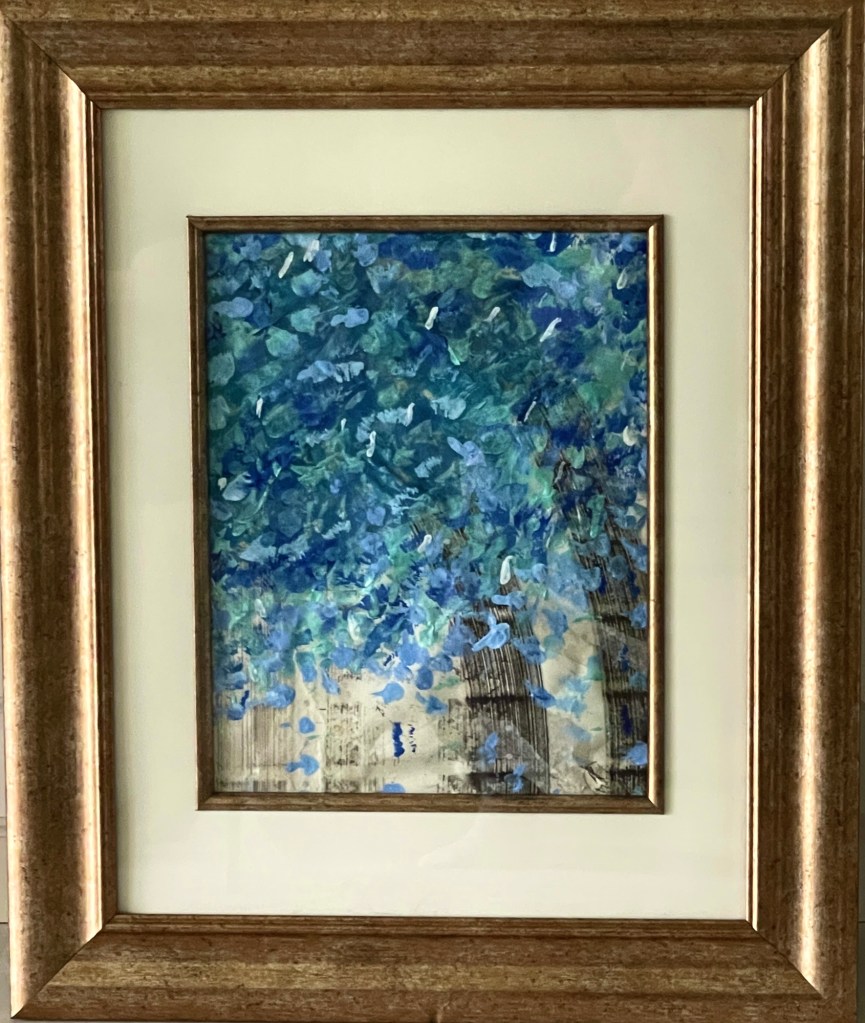
(ink on rice paper)
SEASONS OF DISSOLUTION
The following series of haiku, was created when thinking about the above painting, where flowing gestures suggest forms dissolving into one another — tree, water, sky, shadow. Each poem traces a season, echoing my meditative fragments: loosing myself, meditating on earthly forms, and my desires to be absorbed into nature.
Spring, summer, autumn, and winter appear not as fixed scenes but as states of transformation, where self and world blur. The cycle concludes with a coda, a final gesture in which ink, like breath, vanishes into silence.
Together, the painting and poems offer a contemplative space — a rhythm of becoming and dissolution, inviting viewers to experience art as both meditation and resistance to the fixed boundaries of modern life.
SPRING
Loosing myself here,
green shoots scatter into rain—
earth begins again.
SUMMER
Meditating now,
shadows lengthen everywhere
sky drinks the river.
AUTUMN
Desire opens wide,
to be absorbed into hues
leaves forever fall.
WINTER
Silent branches wait,
the lush swamp regenerates
emptiness holds all.
CODA
Ink pools on rice grain,
petals drift without a trace—
world and self vanish.
More Thoughts considering David Hinton’s interpretations of Ch’an Buddhist writings and Theodor Adorno’s theory on Aesthetics:
David Hinton often emphasizes how Ch’an/Daoist poetics enact absorption into the cosmos, where boundaries between self and world dissolve. The ink on rice paper—its cascading blue-green gestures, fluid layering, and almost-breathing density—evokes what Hinton calls the “landscape-mind” (心境). The brushstrokes resemble drifting leaves, rain, trees, or water, but resist fixing into any single form. This indeterminacy echoes Ch’an practice: the painting isn’t a representation of something outside, but a moment and rather a trace of mind itself moving as landscape. The rice paper, absorbing ink and pigment unevenly, enhances this sense of porousness between gesture and ground, world and self.
Hinton might say the painting allows us to “enter the emptiness” through texture and rhythm: the eye is pulled upward into the canopy of strokes, then downward into the vertical marks beneath, which recall trunks or shadows. The entire work is a field of transformations—momentary presences appearing and vanishing, much like a sudden breeze carrying petals and transforming the landscape.
From Adorno’s Perspective
Adorno would stress the painting’s dialectical tension between form and non-form, autonomy and reconciliation. On one hand, the all-over dispersion of strokes resists the closed composition of traditional representational art; it maintains an openness that refuses clarity. The viewer confronts unresolved tension: is this forest, sky, or pure abstraction? Adorno reminds us that non-identity (Nichtidentität) embodies art’s truth-content: the refusal to reduce life to fixed categories and identities.
Yet, Adorno might also caution that abstraction risks being subsumed into decorative immediacy in the culture industry. The use of ink on rice paper resists this tendency, because it retains historical resonances—Daoist calligraphy, Asian aesthetics, the fragility of the medium. This preserves an aura of resistance, a critique of the uniformity demanded by mass culture. The blue cascade suggests not domination but a fragile harmony with nature—art as a counter-image to instrumental and hierarchical objectives.
 Art by Kate W