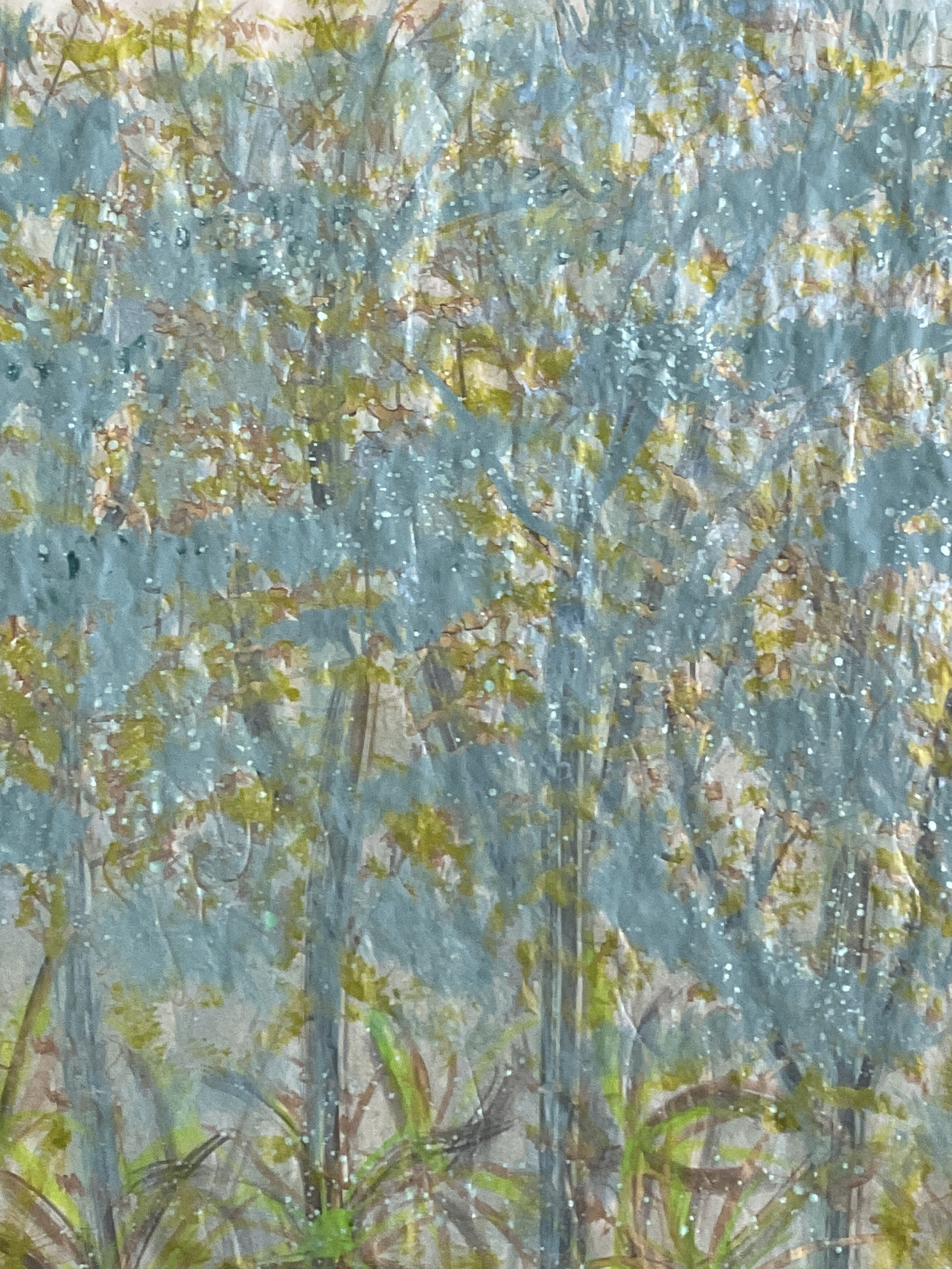
This painting serves as another intersection for the philosophies of David Hinton and Theodor Adorno. It balances between Hinton’s “wild” ecological interconnectedness and Adorno’s insistence on the “non-identity” and friction inherent in modern art.
Here is a critique looking through their lenses.
A David Hinton Perspective: The “Existence-Tissue”
Hinton would likely view this piece as a visual meditation on the Taoist/Ch’an concept of Existence and the Cosmos as a Single Substance.
• The Dissolution of Boundaries: In Hinton’s framework, there is no separation between “mind” and “landscape.” In this painting, the trees and the atmosphere (represented by the blue-grey washes and white stippling) bleed into one another. This illustrates what Hinton would identify as the “Breath-Energy” or Chi, where the solid and the void are part of the same generative fabric.
The way the vertical trunks emerge from a misty, indistinct background reflects Hinton’s idea of Absence (Wu) being the source of Presence (Yu). The painting doesn’t just show trees; it shows trees becoming, out of a primordial mist, capturing the constant flux of the Tao.
A Theodor Adorno Perspective: Aesthetic Autonomy and Friction
Adorno would see how the painting functions as a Negative Dialectic.
Resistance to Consumption: Adorno praised art that is “difficult” or refuses to be a clear “picture” of something. The heavy texture and overlapping layers create a visual “dissonance.” The eye cannot easily rest on a single leaf or branch; it is forced to work through the layers. This resistance prevents the painting from becoming a mere “decoration” or a “pretty forest scene.”
The Mimesis of Shudder: Adorno spoke of the “shudder” one feels when encountering the “otherness” of art. The ghostly, almost skeletal quality of the trees against the hazy blue creates a sense of alienation. Rather than a sentimental view of nature, it presents nature as something autonomous and somewhat indifferent to the human gaze—a core Adornian value.
Truth Content through Fragmentation: The white “snow” or “light” flecks break the continuity of the image. Adorno might argue that these fragments represent the fractures of modern reality. By not offering a perfectly harmonious, photographic view, the painting reveals a “truth” about the complexity and fragmentation of our current relationship with the world.
 Art by Kate W