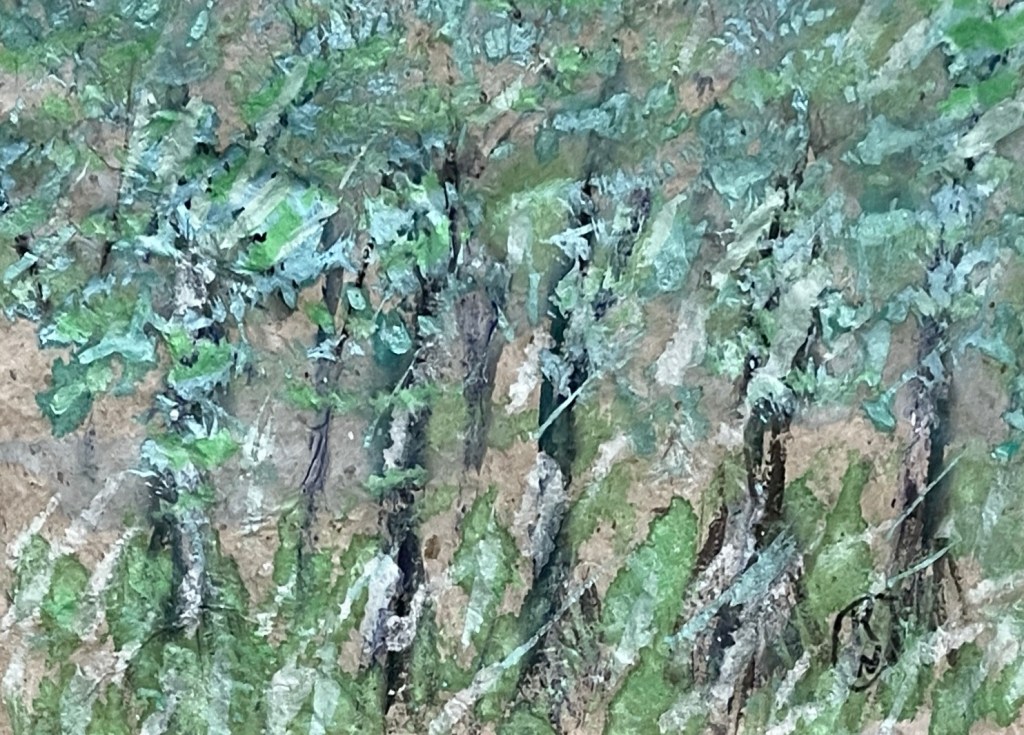
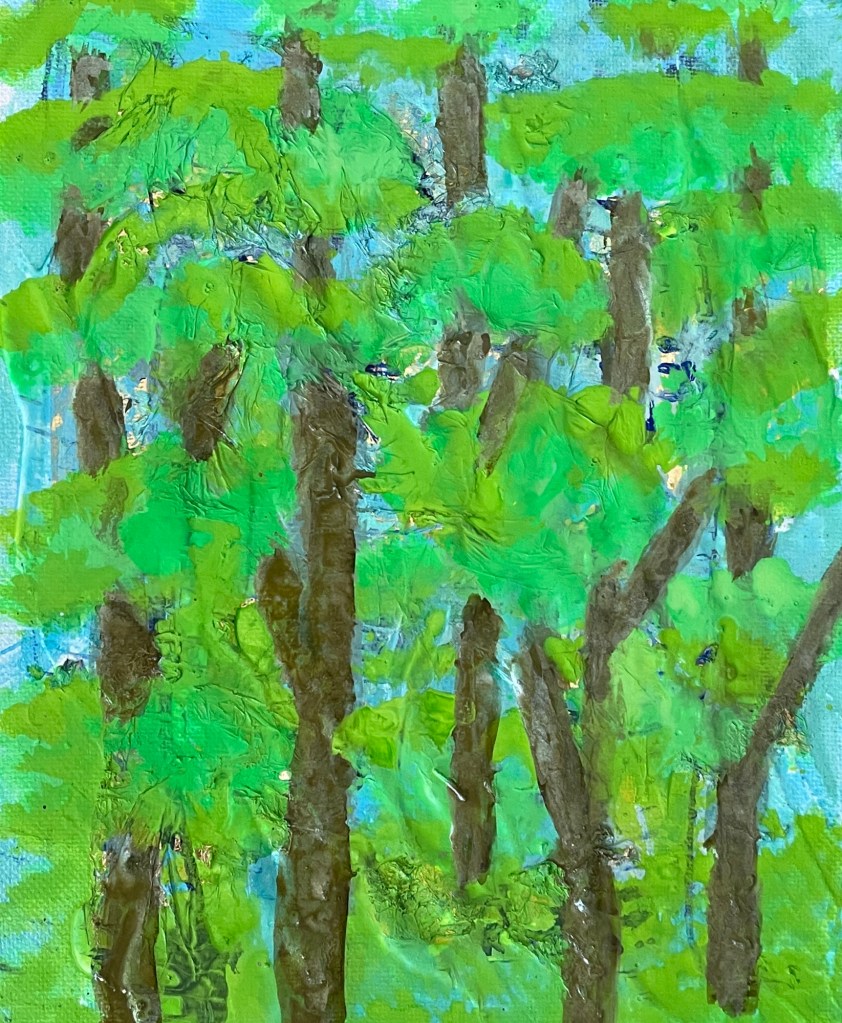
The surface never lies about what it is. In these two pieces there is no illusionistic modeling, no perspectival trickery, no emotive theatrics. And yet—because of color interaction, repetition, thickness, and restraint—the eye cannot help but experience spatial tension.
What works strongly here is the refusal to over-resolve. My paintings are at times ambiguous, (to some, it might seem unfinished) to allow and encourage the viewer’s participation to attach their meaning.
This aligns with my meditation (Ch’an) practice—attention without domination. These are less like paintings of a forest and more like standing inside perception itself, where distinctions blur and the self recedes. the ten thousand things speak.
Adorno discusses resisting the administered image of nature as the postcard forest, the consumable landscape. In these paintings there is no picturesque clarity here, no easy harmony. The surface is fractured, rough, even mildly abrasive. That refusal is critical to my work.
While there is a repetition of vertical forms, almost flirting with pattern, the paintings never settle into decor. Adorno mistrusted beauty that reconciles too easily. While greens are lush, they’re worked, scraped, interrupted. Nature here is not soothing; it’s non-identical—it will not fully submit to concept or pleasure.
There’s also a subtle tension between organic vitality and the structural repetition—a dialectic between life and constraint. The forest feels alive, but also pressed into vertical rhythms that almost echo systems, grids, or laboring forms. That creates an unresolved tension where reconciliation is promised but not delivered.
Hinton’s interpretation of Taoism where emptiness is a major theme and Adorno’s theme of negation converge here.
• Hinton would say: the painting lets the world be what it is, without forcing meaning.
• Adorno would say: the painting tells the truth by refusing false meaning.
The works occupy that shared ground. It is anti-dominant—no mastery over nature, no mastery over the viewer. It asks for duration, consideration, immersion, not ownership, not consumption, not identification. The surface insists on being encountered slowly, bodily, attentively.
If there’s a slight change to be made it might be in the over indulgence or pleasure of the strong green—almost seductively so. Adorno might ask whether pushing a bit more dissonance, interruption, or tonal risk could deepen the work’s resistance. Hinton, on the other hand, might say it’s already enough—because the painting listens.
And that tension—between listening and refusing—might be precisely what gives these two pieces quiet authority.
 Art by Kate W