Truth, Commodification, and the Colonization of Subjectivity
In an era shaped by commodification, surveillance, and market ideology, the search for personal and artistic truth becomes a form of resistance. Theodor Adorno’s critique centers on the conditions wherein life itself becomes contorted by systems of domination and exploitation. For those structurally marginalized—workers, women, artists—the very process of living is often already an adaptation to alienation. Yet within this terrain, the act of making art, particularly when born from inner necessity, can stand as a form of rebellion. The artist’s refusal to conform, her commitment to process, and her search for authenticity exist in tension with the culture industry’s drive to commodify and control. As a systems thinker and feminist, I contend that this tension—between lived experience and cultural expropriation—is not only structural but deeply personal.
Adorno (2005) argued that culture no longer exists outside the logic of exchange. Art becomes product. Identity becomes performance. Expression is filtered through the exchange-market logic. The subject is “colonized”—not merely oppressed externally, but shaped internally by commodified values, desires, and expectations. This colonization of subjectivity, subtle yet, all encompassing, makes genuine acts of freedom increasingly difficult. “Wrong life cannot be lived rightly” (Adorno, 2005, p. 39) is not a resignation, but a diagnosis: the individual, absorbed into chasing a false globalized labor-exchange, within a structurally unequal distribution and production system, is left disoriented and alienated.
Yet the artist’s work, especially when made to not conform, resists. In the act of creation—especially when that creation is not performative, but process-driven—the artist momentarily reclaims her subjectivity. Even if the artist is unconscious of these market forces on her psyche, the act of artmaking asserts an inner truth that stands apart from commodified existence. Here, Adorno’s aesthetics intersect with Jung’s (1959/1968) notion of individuation. Where Adorno locates resistance in formal rupture and negativity, Jung locates it in psychic integration and symbolic expression. The Ch’an Tang Buddhists (@ 600-900 CE) locate their art in the interior being. Today, under 21st Century conditions, I contend the artist, drawing from her unconscious, may not seek rebellion—but she embodies it by producing meaning that the system cannot fully absorb or replicate.
However, once the artwork leaves the studio, it risks becoming a commodity—marketed, theorized, displayed, and ultimately owned. Rosalind Krauss (1985) reminds us that modern and postmodern art exist within systems of citation, signs, and constructed meaning. The artwork, no matter how personal or transformative in its making, becomes a surface—interpreted, consumed, and detached from its original impulse. Even the most authentic act risks being recoded as spectacle. Jackson Pollock, for example, understood this deeply: his emphasis on gesture, action, and presence was a rebellion against the static art of painting reduced to the buying and selling of art. For him, art was in the doing, not the product (Rosenberg, 1952). Yet even Pollock became a cultural icon, absorbed into the very system he disrupted.
This contradiction, to exist in the very structures that reduce us to participants in the commodification market cycle, provokes a tension between authenticity and conformity.
Art, then, needs to be, not the escape from this contradiction—but its most honest expression. The artist who seeks her own voice, who refuses mimicry and trend, who works from unconscious or intuitive necessity—she is not just creating. She is refusing. In this refusal, she does not transcend the system, but she creates a tear in its fabric, a moment of truth in a world of distortion, mediocrity, and conformity.
References
Adorno, T. W. (2005). Minima Moralia: Reflections from damaged life (E. F. N. Jephcott, Trans.). Verso. (Original work published 1951)
Jung, C. G. (1968). The archetypes and the collective unconscious (R. F. C. Hull, Trans.). Princeton University Press. (Original work published 1959)
Krauss, R. (1985). The originality of the avant-garde and other modernist myths. MIT Press.
Rosenberg, H. (1952, December 16). The American action painters. Art News, 51(8).
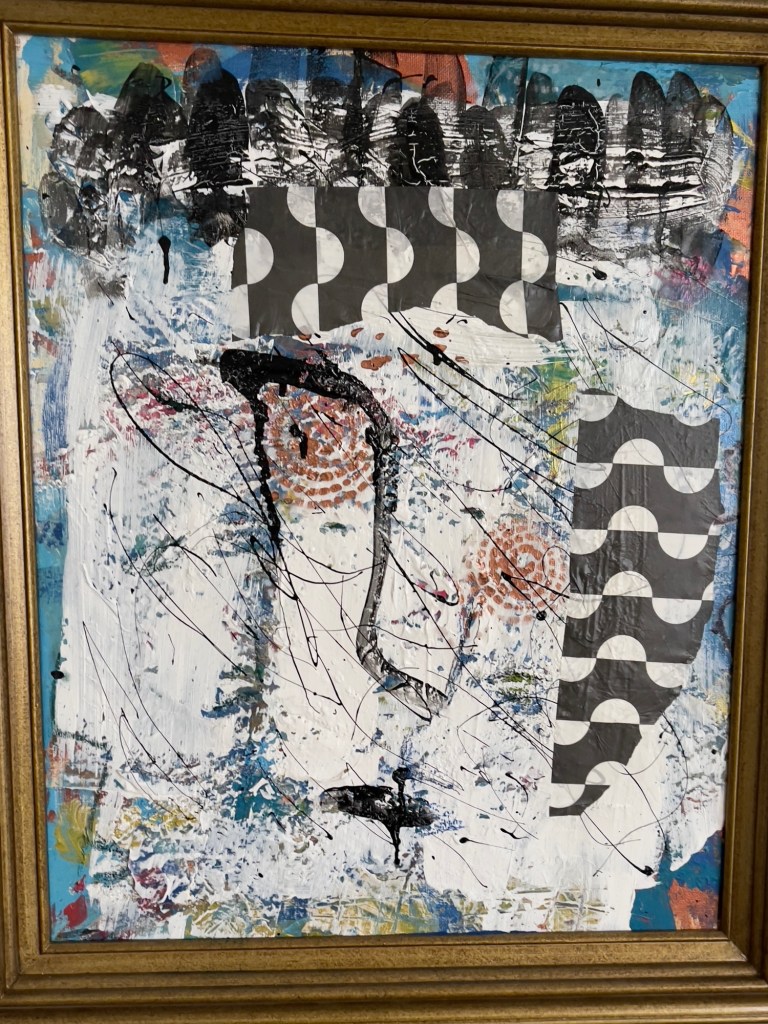
 Art by Kate W