
These three pieces of contemporary sculpture, created in 2023, illuminate Theodor Adorno’s distinction between
1) culinary art—art that flattens perception, which is easy to digest, and soothes the viewer— and what Adorno distinguishes from
2) authentic art which reveals fracture and negativity, emphasizing the contradictions embedded in historical social-relations.
These sculptures resist immediate consumption; they thwart the viewer’s desire for smooth aesthetic gratification. Instead, they present a constellation of formal decisions—uneven textures, asymmetrical shapes, expressive surfaces—that demand reflection rather than passive pleasure.
Adorno presents to us his critique of what he calls Culinary Art. Culinary art, in Adorno’s terms, is characterized by its function as a commodity: it is made to be pleasing, easily digestible, and thus fully assimilated into the economic marketplace of consumer goods. The artworks here decisively reject this model.
Consider, for example, the piece—a vessel-like form, painted in gestural black, white, and yellow. Its rim is jagged, not symmetrical; the surface is layered with rough, visible brushstrokes rather than a glossy, uniform glaze. This unpolished texture resists the kind of smoothness Adorno associates with ideological comfort. The object’s partial reference to the functional form of a cup or vase, and its multiple perspective of asymmetrical facial features gives the viewer its raw, estranged and fractured viewpoints, making it something not easily classified or consumed.
Here Beauty and Negativity are in Tension.
For Adorno, authentic beauty does not erase negativity but contains it within itself. Beauty that is too harmonious or reconciled is suspect—it conceals suffering and contradiction, our human historical conditioning.
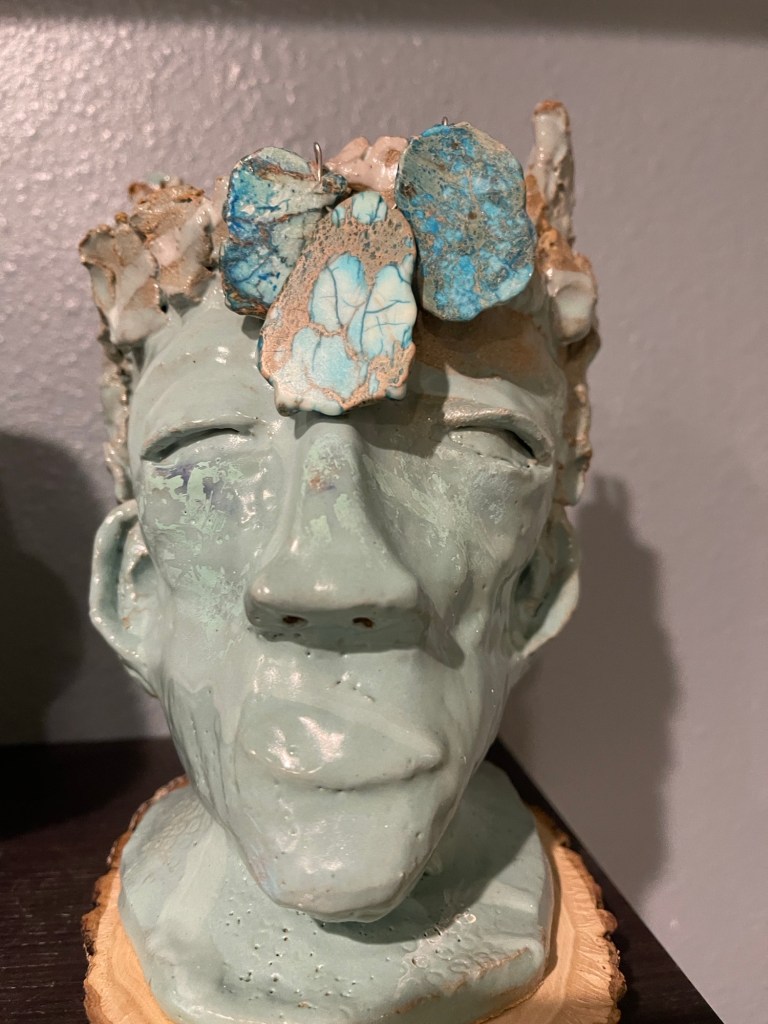
The turquoise glazed ceramic head crowned with irregular stone-like elements, is another example of this dialectic between beauty and un-beauty. The facial features are stylized, asymmetrical, with lips and cheekbones accentuated in ways that evoke both vulnerability and alienation. The stone fragments on the crown are not decorative in a culinary sense; they heighten the tension between natural mineral beauty and the uncanny, mask-like face. In this juxtaposition, the piece demonstrates what Adorno calls art’s “truth content”: it stages contradiction rather than suppressing it.
The Fragmentation of Authentic Art
Adorno’s Aesthetic Theory repeatedly insists that fracture, asymmetry, and dissonance are not aesthetic defects but the mark of historical truth. Art must, Adorno writes, “appear broken precisely in order to remain faithful to what it expresses.”
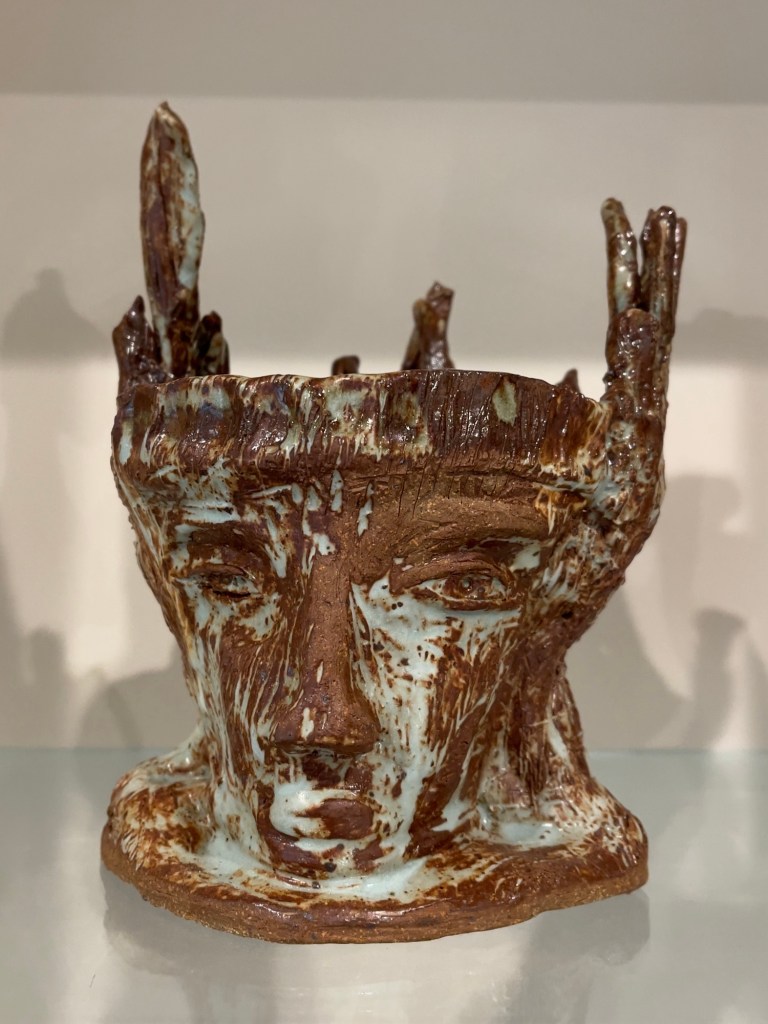
This idea resonates in the sculpture glazed with a reddish-brown head and projecting crown-like spikes. The face emerges as neither entirely figurative nor fully abstract. The glaze is patchy, emphasizing process over perfection. Here, the asymmetry and fragmentation are not merely formal—Instead of offering the consoling wholeness of traditional beauty, this work demonstrates how the multi-viewpoints become a precondition for authenticity in its non-identity.
Resisting Immediate Consumption:
Unlike culinary art, which encourages the viewer to consume and move on, these sculptures ask for a different mode of engagement. They require the viewer to contemplate surface irregularities, partial references to archetypes, and the play of material and form. They withhold easy interpretation. In fact, they are designed to slow perception down.
In this respect, they align with Adorno’s insistence that true art resists assimilation. As he puts it:
“Art is modern by its own law of movement, that of the unending effort to escape from the culinary, to oppose the consumer society’s demand for amusement.” (Aesthetic Theory, p. 15.)
Conclusion: The Ethical Dimension of Form
Adorno argued that in an age of total commodification, aesthetic form itself becomes an ethical stance. By rejecting smoothness, by refusing to be easily consumable, art retains the capacity to disclose historical and social truths.
These sculptures are created as a refusal. In their fractured surfaces and resistance to decorative comfort, they embody a commitment to authenticity. They are, in Adorno’s sense, works that preserve the dignity of art as critique, not culinary pleasure.
Works Cited
Adorno, T. W. (1997). Aesthetic Theory (R. Hullot-Kentor, Trans.). Minneapolis: University of Minnesota Press.
Adorno, T. W., & Horkheimer, M. (2002). Dialectic of Enlightenment (E. Jephcott, Trans.). Stanford: Stanford University Press.
 Art by Kate W