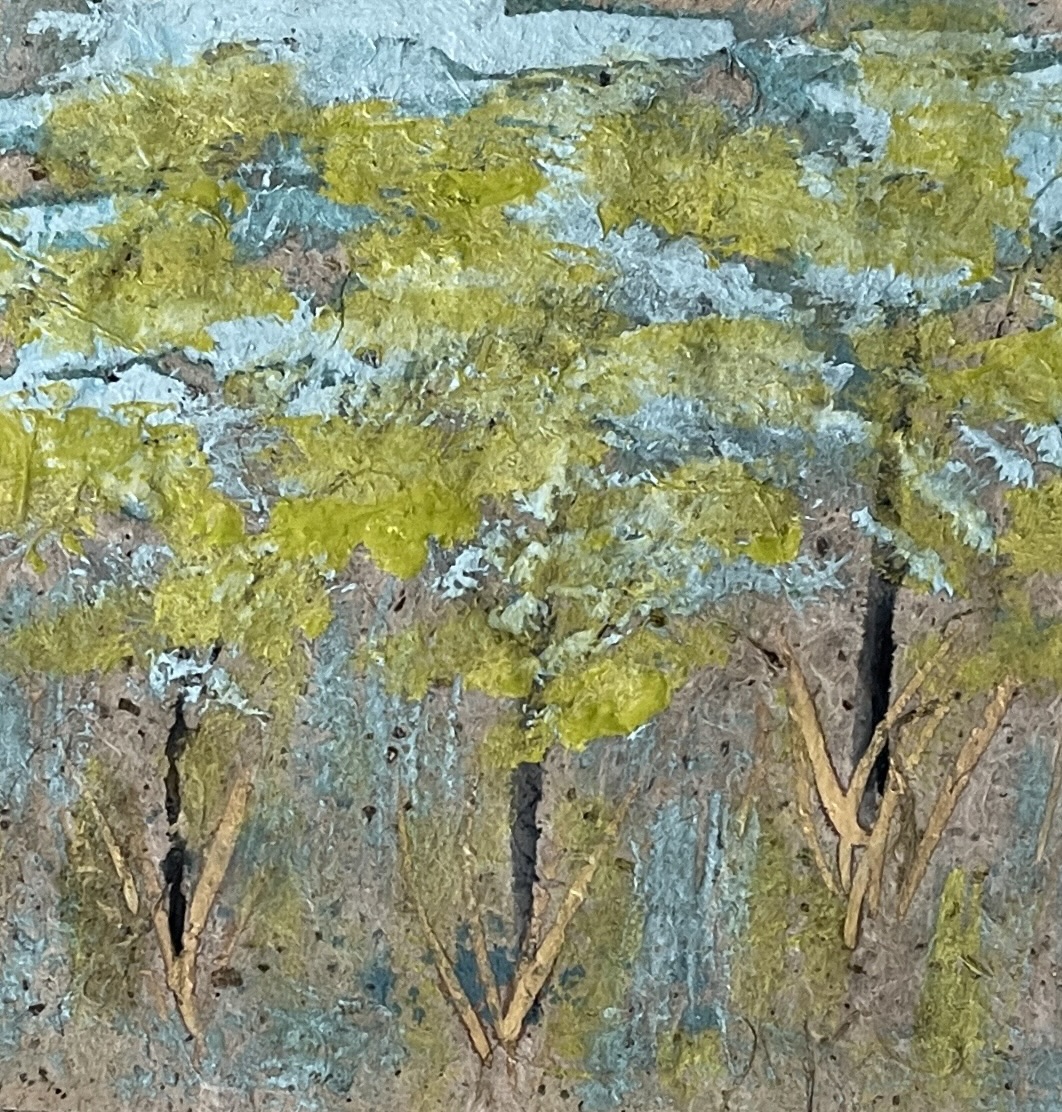
Using David Hinton’s philosophy based on Ch’an Buddhism and even more ancient, Taoist, philosophy, we are encouraged to look at these recent paintings not as a “picture of trees,” but as a manifestation of Existence-Tissue—the Ch’an and Taoist concept that the cosmos is a single, generative organism where there is no separation between the “viewer” and the “viewed.”
The two pieces, with their tactile textures and blurred boundaries, align with several of Hinton’s core tenets:
1. The Dance of Absence and Presence
Hinton often speaks of the “dance between nothing and everything.” In the heavy, impasto-like texture of the paint and ink (Presence) sits atop a rough, earthy substrate of hand made rice paper (Absence/Origin). By allowing the raw material of the “canvas” to show through the trees, the Taoist idea that all form emerges from a primordial emptiness and eventually dissolves back into it is illustrated. The trees aren’t “on” the background; they are the background “treeing”
2. Tzu-jan (Occurrence Appearing of Itself): Implies the artist and energy or qi of the brush and the ink are in flow, creating a single thread in a massive, vibrating fabric. As the artist and the viewer, we are part of the “spontaneous self-generation” of the entire cosmos.
In the paintings, the way the dark shadows swallow the trunks or the way the paint thins out is just as much tzu-jan as the bright leaves. The “coming into being” and the “going out of being” are the same movement. It is active, wild, and spontaneous.
In Ch’an, Tzu-jan refers to things happening spontaneously, without a detached “ego” directing them.
The action of the brushwork is fast and rhythmic. Hinton would likely celebrate the “wildness” of the marks—the way the yellow-green dabs of the canopy feel like they “happened” rather than were meticulously “placed.” This mirrors the way a tree grows: it doesn’t think about growing; it simply unfolds.

3. The Dissolution of Dualism
Hinton argues that Western art often creates a “window” that separates the observer from nature. In contrast, Ch’an art seeks to “rewild the mind” by removing the distance.
• Critique of Image 1 vs. Image 2: Image 1 provides a bit more “structure” with the vertical trunks, giving the viewer a stable place to stand.
• Image 2 is even more “Hintonian.” The trunks are darker, more recessed, and the foliage is more atmospheric. The colors bleed into each other, making it hard to tell where one tree ends and the atmosphere begins. This represents the “existence-tissue”—the idea that the air, the light, and the wood are all made of the same fundamental energy.
4. Landscape as “Mountain -Home”
For Hinton, the “wild” is not a place we visit; it is our “original home.” The choice of colors—muted teals, ochres, and olive greens—creates a sense of “ancientness.” It feels like a landscape that has always existed.
The lack of a clear horizon line or human markers forces the viewer to “dwell” inside the forest rather than look at it from a distance. These paintings capture a “Wild Mind”—a consciousness that mirrors the complexity and silence of the woods.
In summation, These works avoid the “pretty” sentimentality of landscape painting and instead lean into the raw, generative power of matter in the cosmos. Hinton would likely see these as meditations on the “dark enigma” (the source of all things), where the ink itself is as alive as the trees it represents.
 Art by Kate W