“MIND 心 CH’I-WEAVE MIND 意 In Ch’an parlance, mind principally refers to consciousness emptied of all contents, a state revealed through deep meditation: hence, mind as “original-nature” or “Buddha-nature.” This consciousness in its original-nature is nothing other than Absence, that generative cosmological tissue—for it is the empty source of thought and memory, and also an empty mirror open via perception to the ten thousand things of Presence. So once again: Ch’an’s conceptual world as fundamentally Taoist in nature. (Hinton p. 331)
“Ch’an sometimes also uses mind seemingly in the common English sense of the word, as the center of language and thought and memory, the mental apparatus of identity. It seems the same, but Taoist/Ch’an cosmology/ontology makes it radically different. Those processes of mind were described as 意, which has a range of meanings: “intentionality,” “desire,” “meaning,” “insight,” “thought,” “intelligence,” “mind” (the faculty of thought). The natural Western assumption would be that these meanings refer to human consciousness, but 意 is also often used philosophically in describing the non-human world, as the “intentionality/desire/intelligence” that shapes the ongoing cosmological process of change and transformation (here it is virtually synonymous with inner-pattern). Each particular thing, at its very origin, has its own 意, as does the Cosmos as a whole. 意 can therefore be described as the “intentionality/intelligence/desire” infusing Absence (or Tao/Way) and shaping its burgeoning forth into Presence, the ten thousand things of this Cosmos. It could also be described as the intentionality, the inherent ordering capacity, shaping the creative force of ch’i. This range of meaning links human intention/thought to the originary movements of the Cosmos—for it operates in a cosmological context recognizing an “intelligence” that infuses all existence, and of which human thought is but one manifestation. So 意 is a capacity that human thought and emotion share with wild landscape and, indeed, the entire Cosmos, a reflection of the Chinese assumption that the human and non-human form a single tissue that “thinks” and “wants.” Hence, thought/identity is not a transcendental spirit-realm separate from and looking out on reality, as we assume in the West. Instead, it is woven wholly into the ever-generative ch’i-tissue, which is to say they are woven wholly into a living “intelligent” Cosmos—and so, it seems best translated as “ch’i-weave mind,” “ch’i-weave insight,” “ch’i-weave thought,” etc. (p. 331-332)
Hinton, David, (2023) The way of ch’an essential texts of the original Tradition, Shamhala Publication, Boulder, Co,
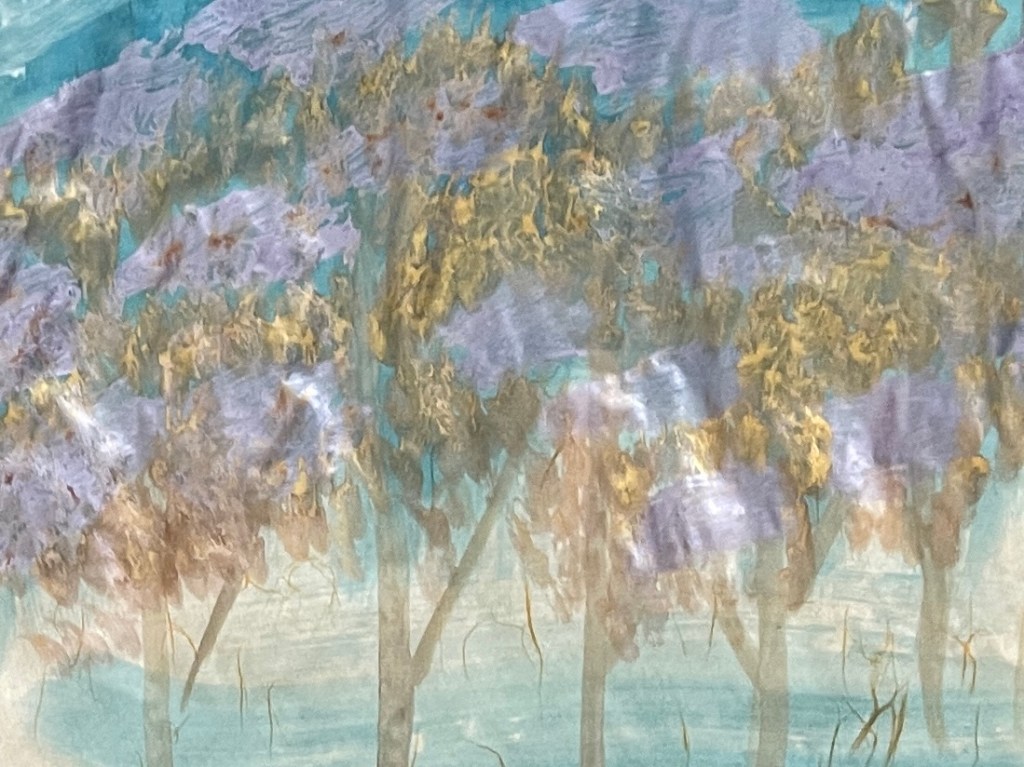
 Art by Kate W