
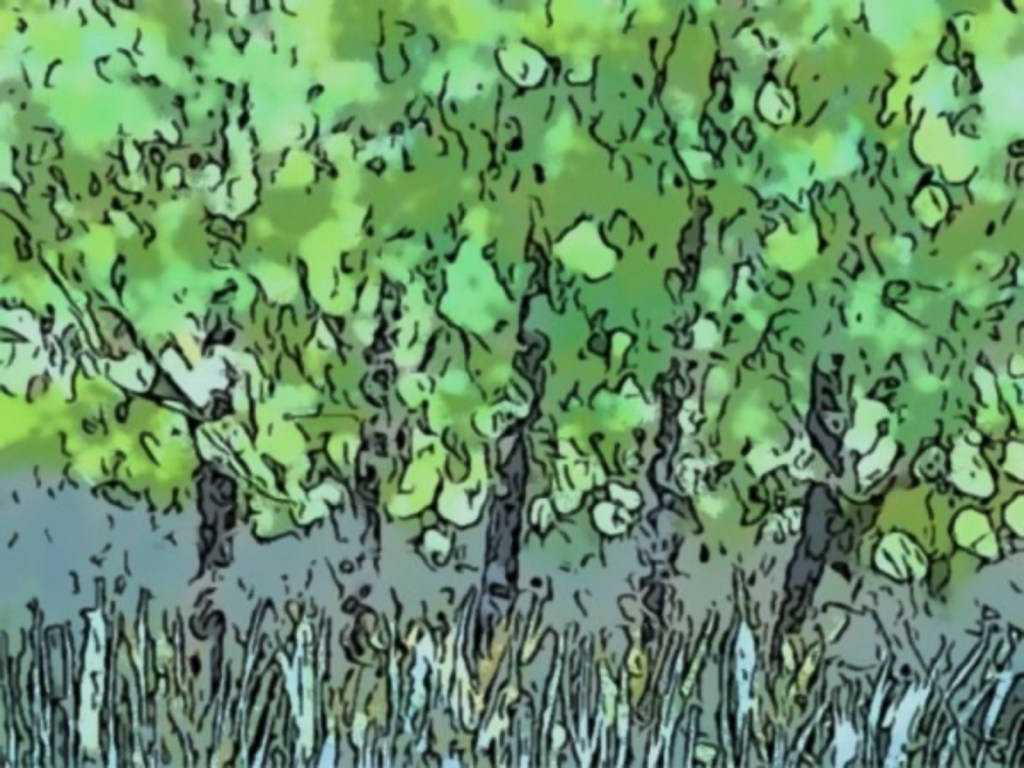
In David Hinton’s Ch’an-inflected understanding of landscape, the world is a single breathing qi moving through form, dissolving form, reshaping it. This swamp scene is rendered not as discrete objects but as an atmosphere—an inter-permeation of leaf-breath, trunk-line, and ground-texture. The colors dissolve into one another like weather, not like objects, which places this squarely in the lineage of landscape as cosmology.
The drifting greens and yellows read like cosmic respiration: each leaf a brief condensation of energy, each line a trace of that ongoing movement.
The forms are intentionally unstable—edges quiver, branches melt and reform—capturing Hinton’s notion that all things are “ten thousand happenings” momentarily gathering.
The vertical trunks punctuate the image like calligraphic strokes, suggesting that the swamp is written into being, a script in which the brush follows.
Adorno’s Lens: Form, Non-Identity, and Nature’s Resisting Voice
From Adorno’s perspective, these pieces resist the domination of nature by refusing clear, closed forms. Instead of giving us “trees” as idealized objects, these paintings are an experience of the trees’ presence—ambiguous, vibrating, resistant to aesthetic capture. This aligns with Adorno’s insistence that true art preserves the non-identical, the aspects of reality that concepts cannot fully grasp.

The swamp is not an object to be owned, organized, or beautified; it is a dynamic field that refuses capture. These works negate the view of the patriarchal narrative as mechanisms of domination over Earth.
Adorno would say the paintings “think through form,” and here the thinking is:
Nature is process, not property. Presence is flux, not possession.
 Art by Kate W