From Genesis to Geopolitics: The Shadow of Jewish Patriarchy
Introduction
The foundational texts of the Abrahamic faiths—Judaism, Christianity, and Islam—serve as the moral and structural blueprints for Western and Middle Eastern civilizations. However, a critical examination of the Hebrew Bible reveals a persistent thread of misogyny that transcends mere historical context. By examining the marginalization, objectification, and exclusion of women within Jewish scripture, one can argue that this internal “othering” of the feminine creates a psychological blueprint for the external “othering” of political and religious rivals today.
The Architectures of Exclusion
The subjugation of women begins at the moment of creation. In the traditional reading of Genesis 3, Eve is cast as the primary transgressor, the conduit through which sin and death enter the world. This narrative is further darkened by the extra-biblical myth of Lilith, Adam’s purported first wife, who was demonized for demanding equality. These figures establish a “foundational distrust” of female autonomy.
When women do appear as “Women of Valor” (Eshet Chayil), they often serve as tokens or are celebrated primarily for their utility to the patriarchal line. While figures like Deborah or Esther are notable, they are exceptions that prove the rule of male dominance. More often, the “great” women of the Bible are defined by their physical beauty or their reproductive value. In Genesis 12 and 20, Sarah is twice used as a political pawn by Abraham, who exploits her beauty for his own safety, effectively objectifying the matriarch to preserve the patriarch.
Violence and the “Othered” Woman
The text’s treatment of women often veers into overt dehumanization, particularly regarding those outside the immediate power structure:
• The Banishment of Hagar: In Genesis 21, Abraham heeds Sarah’s jealousy and casts Hagar—his second wife and the mother of his firstborn—into the desert. This act not only displays a callous disregard for the female “other” but also serves as the biblical root of the animosity between the lines of Isaac and Ishmael.
• Sanctioned Violence: Laws regarding warfare, such as those in Deuteronomy 21:10-14, outline the treatment of “beautiful captive women,” essentially codifying a form of state-sanctioned sexual subjugation of the conquered.
The Projection of the Shadow
If a culture is raised on a text that treats half its population as inherently prone to evil (Eve), disposable (Hagar), or a prize of war (the captive), it creates a deep-seated “shadow” in the collective unconscious.
Psychologically, when a group fails to integrate or reconcile with its own internal “other” (women), it frequently projects that repressed hostility outward. The exclusion of women from historical leadership and the “covert hate” found in rigid interpretations of the law may well inform the modern inability to see “the other”—whether they be Palestinians, rival Jewish sects, or leftist secularists—as fully human and deserving of equal dignity.
In summary, similar to Simone de Beauvoir’s treatise, The Second Sex, it is my contention that the “othering” of the feminine, in society at large, is the original template for all subsequent tribalism, violence, and hate.
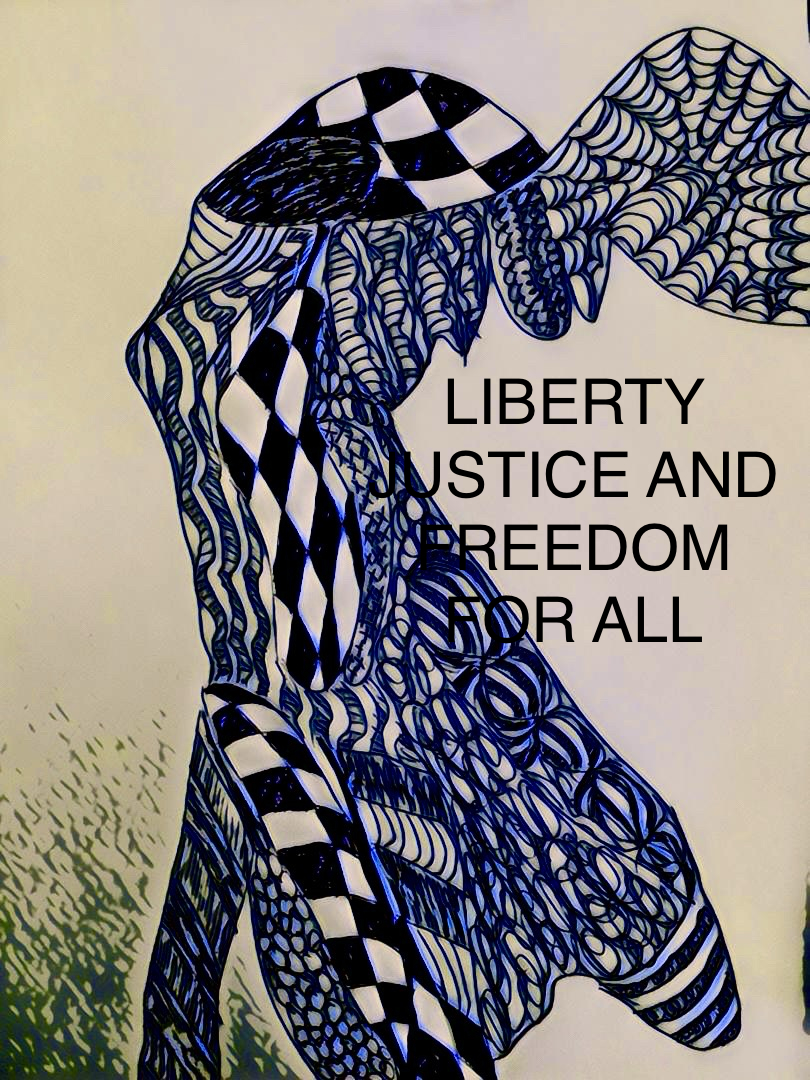
 Art by Kate W