
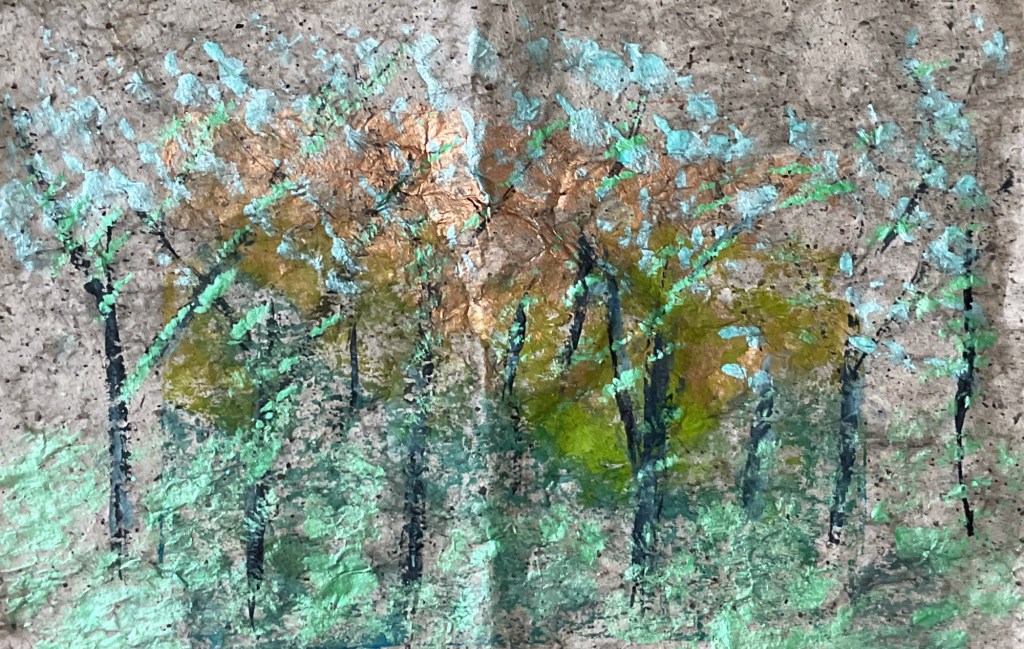
David Hinton, writing on the Ch’an Buddhist traditions and interpreting very early Chinese writings, often frames art as a practice of dissolving the boundaries between self and cosmos, evoking the Dao’s spontaneous unfolding of the present moment (Hinton, 2012). This painting’s layered greens, yellows, and copper do not “represent” the wetlands so much as it captures the flow of nature, allowing the viewer to be immersed into the rhythms of leaf, branch, and shadow. The brushstrokes feel less like controlled depiction than like the ziran (自然, self-so-ing) of nature itself. The Tang Dynasty artists in their expressive landscapes and poetry were aware of this and depicted it in their paintings and poetry. They understood the landscape is not “out there” but a field of energies mirroring the unconscious; a painting in which if the viewer participates while being in the moment, can understand Hinton’s sense that art “returns us to the cosmic tissue of existence” (Hinton, 2019).
Stephen Hinton, writing extensively on Adorno and modernism, suggests that the autonomy of a piece of genuine artwork, is a tension-filled construct: it resists the culture industry while carrying the traces of social reality (Hinton, 2016). The painting’s semi-abstract swamp scene stands between figuration and abstraction, evoking Impressionist fragmentation but refusing mere decorative appeal. The energy and action from the brushwork presents us with a painting that viewers are not able to consume quickly. This in itself, stages a resistance to commodified transparency. It holds together a contradiction: while it presents the elements of art in a natural flux, it also refuses to yield to the narrow confines the culture industry promotes as beauty.
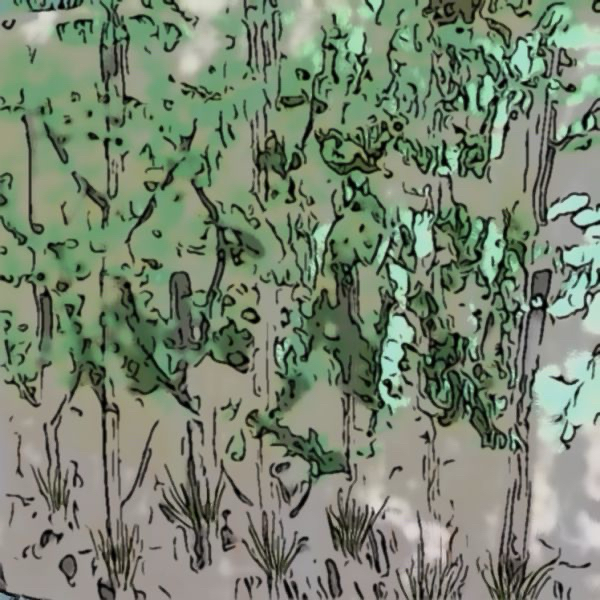
For Adorno, authentic art reveals truth not through harmony but through the fractures and tensions it embodies (Adorno, 1997/2004). It can be argued that this painting resists the clarity often demanded by the culture industry, as it does not present a postcard scene, rather it is a dense, almost unreadable thicket. This opacity functions as critique: the wetlands appear fractured, layered, even dissonant, evoking what Adorno calls art’s “semblance character” (German word is Schein) that both reveals and conceals reality. Its unresolved tensions mirror a world that is itself fractured by domination, yet it is within that fracture that present the possibilities. This painting refuses to mimic a falsely harmonious world and instead reveals fracture as both the condition of reality and the possibility of transcending it.
References
Adorno, T. W. (1997/2004). Aesthetic Theory (R. Hullot-Kentor, Trans.). Continuum.
Hinton, D. (2012). Hunger Mountain: A Field Guide to Mind and Landscape. Shambhala.
Hinton, D. (2019). The Wilds of Poetry: Adventures in Mind and Landscape. Shambhala.
Hinton, S. (2016). Weill’s Musical Theater: Stages of Reform. University of California Press.
 Art by Kate W
Leave a comment