
For Adorno, there is no such thing as a purely immediate experience of art (or of nature, for that matter).
He uses the word, Immediate, to mean something given in its raw, untouched form, as though we could encounter “the thing itself” without interpretation, history, or framing. Romantic aesthetics often longed for this kind of immediacy — a direct communion with beauty, nature, or G-d.
But Adorno insists this is an illusion as what we see, feel, and represent is always mediated by concepts, history, social structures, and the materials of the artwork. Even when art seems “natural,” it carries with it layers of technique, culture, and tradition.
In Aesthetic Theory, he puts it this way:
“Nothing in art is immediate; every aesthetic element is mediated through the totality of the work and through history.” (Adorno, Aesthetic Theory, trans. Hullot-Kentor, 1997, p. 120)
So, in Adorno’s thought—Nature itself is mediated: our view of a tree, for example, is shaped by cultural categories, memory, language (“tree”), and the history of landscape painting.
He claims, Art reveals this mediation because it is not simply a copy of the natural world but a constructed object that makes us aware of how representation itself works. Rosalind Krauss argues this point as well.

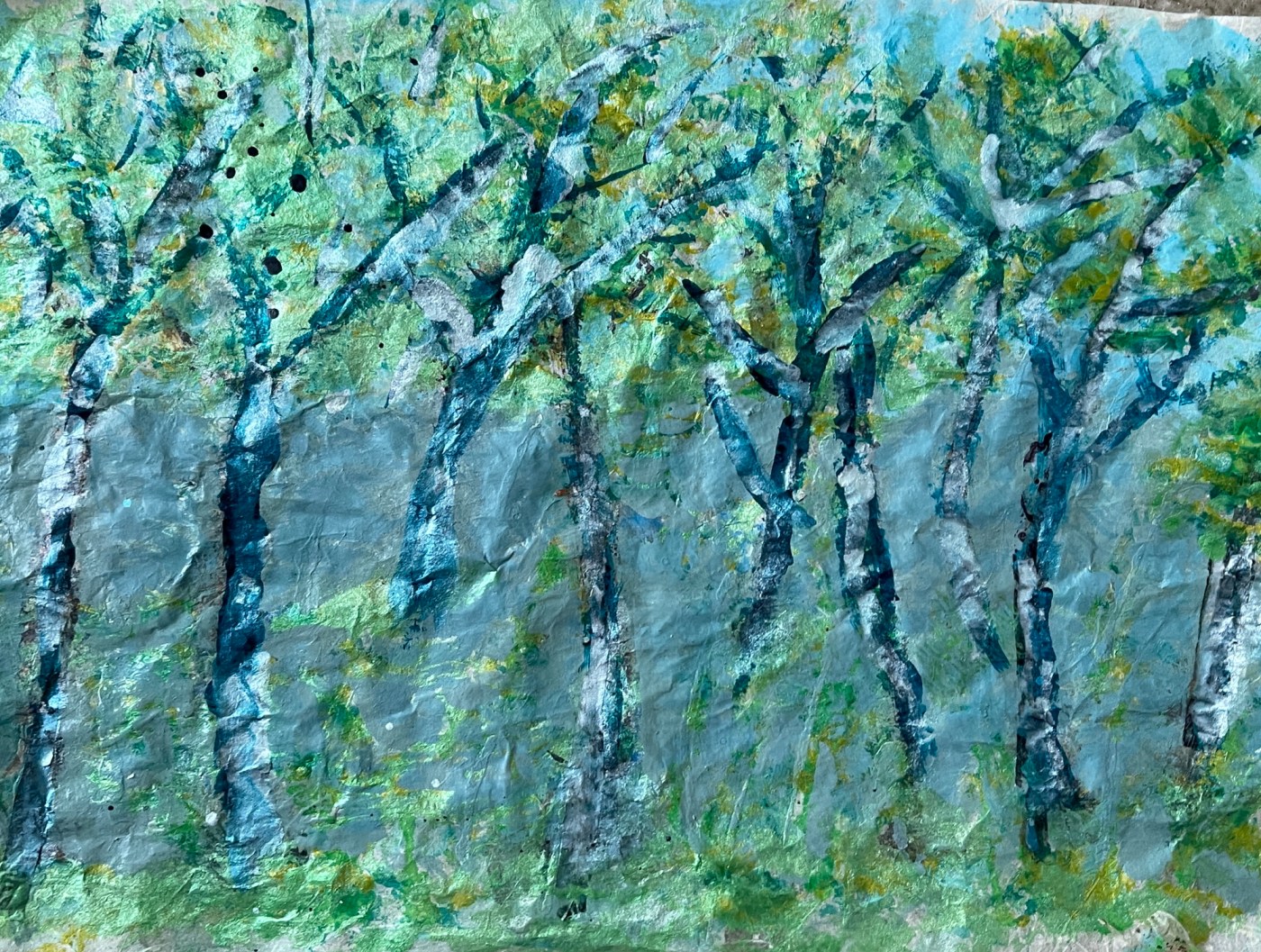
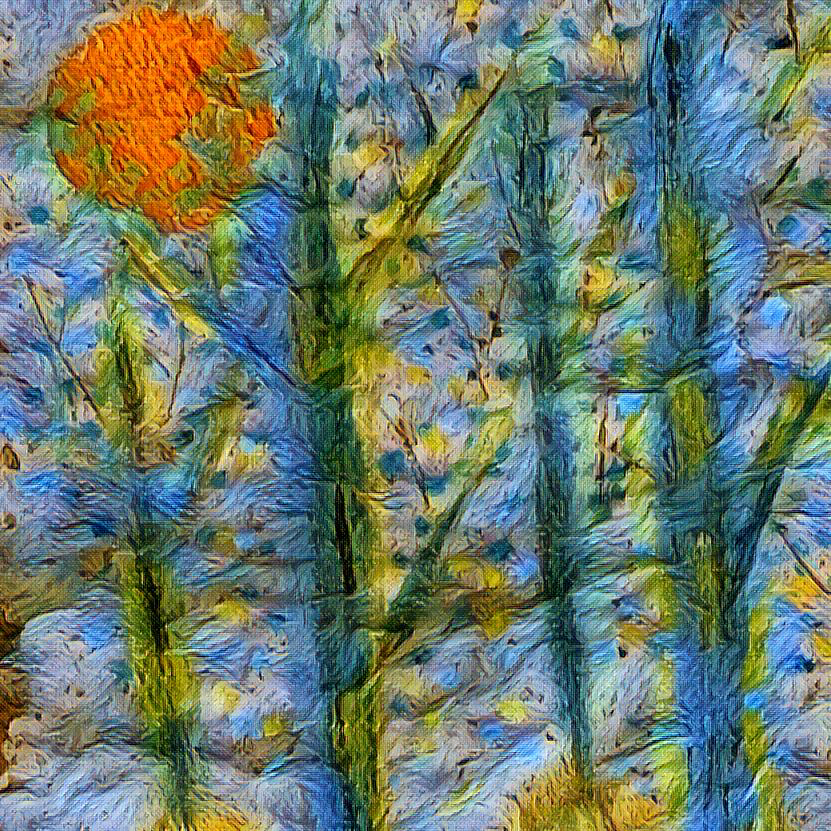
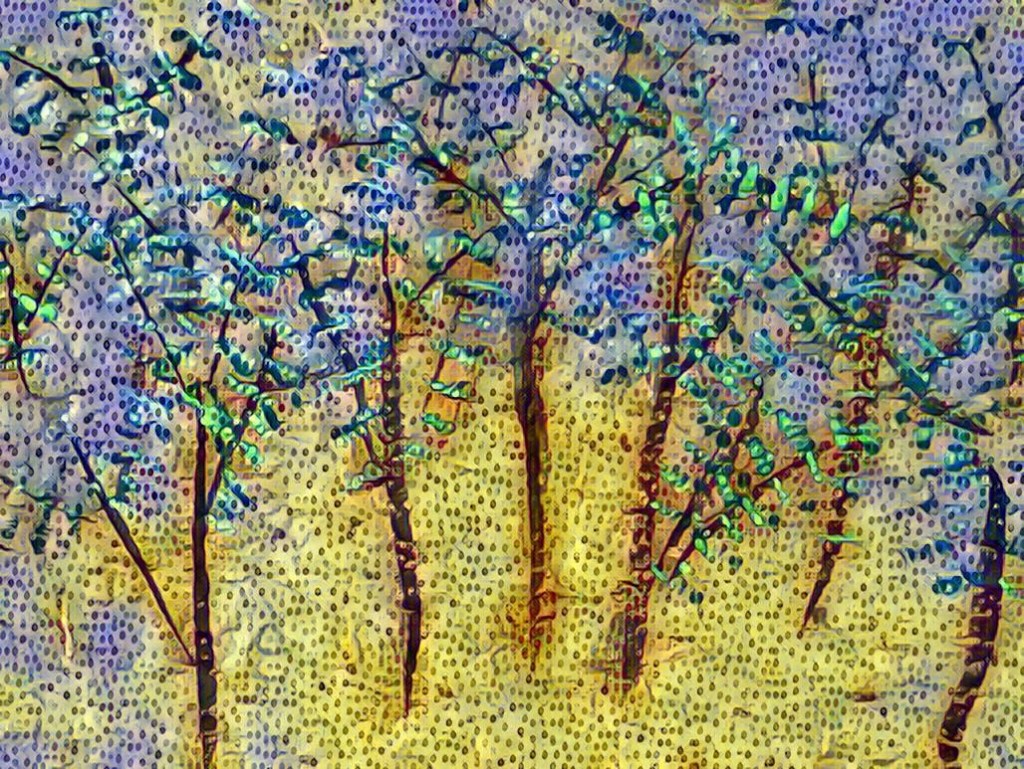
In these few paintings, there is not an attempt to deceive the eye into believing we are looking at literal trees (as, say, in hyper-realism). That would lean toward an illusion of immediacy. Instead, the visible brushstrokes, textured surface, and shimmering pigments constantly remind the viewer that this is a painting — a human construction. This is the artifice of the work.
Adorno claims the painting manifests as a mediation: it acknowledges that our experience of “trees” here is filtered through pigment, paper, and artistic decision.
Thus, the work resists collapsing into “pure nature.” It allows us to sense both the natural subject (trees, light, leaves) and the fact that it is always refracted through an artistic and cultural medium.

 Art by Kate W
Leave a comment