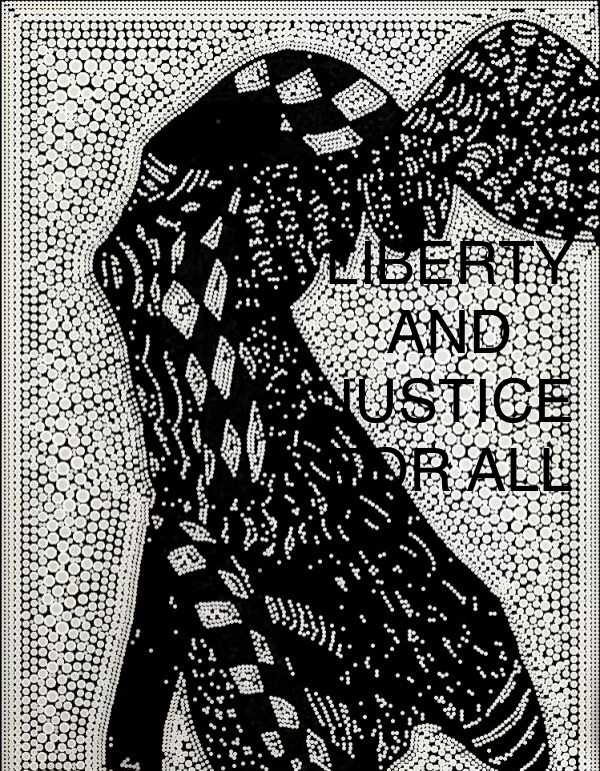
When viewed through the lenses of Theodor Adorno and David Hinton, this Nike art piece moves beyond mere graphic design into a philosophical conflict between the “fractured life” of modern society and the lost unity of existence.
This brief essay will highlight some of Theodore Adorno’s ideas on the Aesthetics of Art and David Hinton’s ideas on the Tao and the mind as cosmic landscape.
Theodor Adorno
For Adorno, art’s truth-content lies in its ability to resist the “Culture Industry”—the machine that turns everything into a standardized product for sale in the market.
• The Critique of the Pledge: Adorno argues that in a market driven by profits, “liberty” and “justice” become empty slogans—a “false democracy” where we are promised freedom but given the primary task of consuming and producing for the marketplace. So to place these words over a fragmented, stippled Nike silhouette, I am suggesting that these ideals are weathered and broken, as the sculpture itself.
• Identity Thinking: Adorno warned against “identity thinking,” so By breaking Nike into dots and lines, I am resisting the “shackle” of her being just a famous statue. She becomes a “cipher of society,” a puzzle that the viewer must struggle to interpret rather than a product to be instantly recognized.
David Hinton:
David Hinton’s philosophy focuses on our separation from the “Wild Mind”—the ancient, primal unity between humans and the cosmos, found in Neolithic and Paleolithic Goddess culture.
• The Paleolithic Origin: Hinton often speaks of how Patriarchy and Western civilization (beginning with the Greeks as referenced by the sculpture,) created a “wound” by separating the “self” from “nature”. In this work, Nike—the goddess of victory—is a fossil of that Greek consciousness. Her fragmented form represents the moment humanity began to break away from the “all-encompassing life-giving organism”, that was reverent in Goddess cultures.
David Hinton provides a counterpoint, viewing the Greek “invention of democracy” not as a political triumph, but as a step in the “Western PATRIARCHY wound”—the separation of human consciousness from the “Wild Mind” of the cosmos.
• Presence and Absence: The “fragmented” aesthetic mirrors the Taoist-inspired focus on “Presence and Absence” found in Hinton’s translations. Nike is a “fossil of consciousness”. The white space between the lines is not “empty” but represents the “primordial silence” from which all “liberty” must emerge.
• A Paleolithic Return: While the text “LIBERTY AND JUSTICE FOR ALL” is a modern linguistic construct, the visual energy of the piece reaches back toward a “Paleolithic” unity. The “Nike” Goddess becomes a “Way” (Tao) through which the viewer experiences the “all-encompassing life-giving organism. “ It therefore becomes more than just a political statement.
For more readings on Adorno and Hinton see below:
Adorno, T. W. (1970). Aesthetic Theory (G. Adorno & R. Tiedemann, Eds.; C. Lenhardt, Trans.). Routledge & Kegan Paul.
Adorno, T. W. (1951). Minima Moralia: Reflections from Damaged Life (E. F. N. Jephcott, Trans.). NLB.
Adorno, T. W., & Horkheimer, M. (1947). Dialectic of Enlightenment (J. Cumming, Trans.). Herder and Herder.
Hinton, D. (2002). The Selected Poems of Tu Fu. New Directions.
Hinton, D. (2017). The Wild Mind of India: Landscapes of the Ancient Mind. Shambhala Publications.
 Art by Kate W
Leave a comment