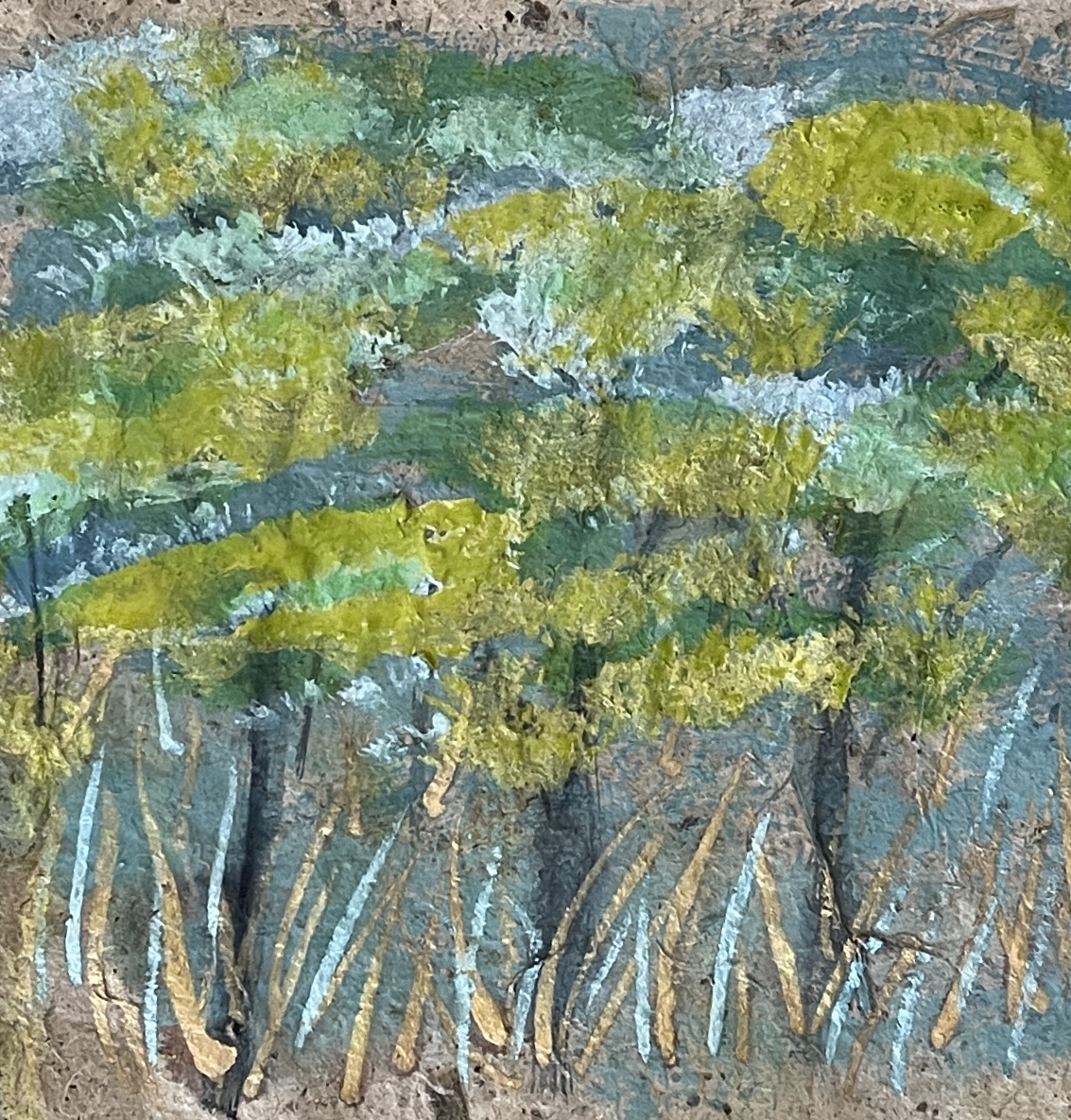
This analysis of the above painting, using three different lenses to focus on different viewpoints, gives a 360 degree perspective. The subject matter of the critique includes: truth-tension (Adorno), plastic vitality (Hofmann), and ontological presence (Hinton). Each reveals a different dimension of what is already occurring in this work.
I. For Adorno, the artwork’s truth resides not in harmony, but in its refusal to reconcile contradictions. The painting embodies this refusal.
1. Non-identity and resistance to conceptual capture
This is recognizably a grove or forest canopy, yet it refuses total mimetic “landscape.” The trunks dissolve into strokes, and the canopy becomes a variable field of layered marks. The image oscillates between:
• representation (trees, foliage)
• and autonomous painterly material (pigment, gesture, surface)
This oscillation is essential. Adorno argued that authentic art preserves the non-identical—that which resists being reduced to a concept. I am not depicting trees, nor attempting to have this be an illustration of trees. They are presences emerging from matter itself.
The vertical strokes especially resist descriptive closure. They are not fully trunks; they are traces of emergence.
2. Sedimentation and historical memory in matter
The layered greens, ochres, and blues feel accumulated rather than applied. Adorno called this sedimentation—history embedded in form.
The work does not present nature as idyllic unity for easy consumption. Instead, it shows nature as fractured, layered, and temporally dense. The dry, earthen substrate asserting itself through the paint prevents illusionistic escape. The painting refuses to let us forget its material truth.
Nature here is not consumed as image—it remains resistant.
3. Truth through restraint rather than expressionism
Adorno distrusted purely expressive gesturalism when it became cliché. the quiet layering, the absence of dramatic gestural assertion— these aspects show restraint and preserves the authenticity and autonomy of the painting.
This is not a painting of emotional discharge. It is a painting of attention.
Truth emerges not through intensity, but through its creation in a layered process. The viewer can see this process to state a fidelity to process.
II. Hans Hofmann: Push–pull and the life of pictorial space
Hofmann would immediately recognize this work as spatially alive—not through perspective, but through relational color forces.
1. Push–pull through chromatic opposition Brings forth the dynamic interplay of colors; Warm yellow-greens advance, Cool blue-greens recede, Pale blue verticals advance suddenly against darker ground
2, Space expands and contracts continuously.
This creates what Hofmann called plastic reality—space generated through color relationships rather than illusionistic depth.
III. Hinton, drawing on Chan/Daoist ontology, would see this painting not as depiction but as event—a moment of reality emerging into visibility.
1.Form arising from emptiness
Notice how the forms emerge from the raw ground rather than covering it. The substrate remains visible and active.
This corresponds to Hinton’s idea that reality is not constructed, but revealed through attentive presence.
The painting does not impose order, the order emerges.
2. The trees breathe.
Hinton writes of landscapes not as objects, but as manifestations of ongoing process. The painting captures this immersion of cosmology. Hinton would argue that the painting is in tune with the qi, where qi is not fixed, but everything is becoming.
From these three perspectives, I contend the following Synthesis:
• Adorno: The painting preserves truth through unresolved material tension.
• Hofmann: The painting lives through relational color forces generating autonomous space.
• Hinton: The painting allows the cosmic reality to emerge without conceptual imposition.
The painting exists in a state of quiet autonomy and authenticity.
It neither dramatizes nor illustrates.
It reveals.
 Art by Kate W
Leave a comment