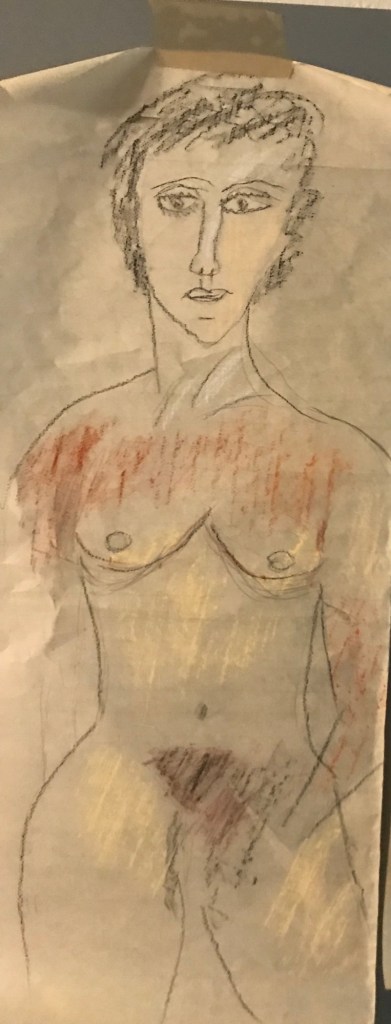
These two figures emerge through an artistic process of transformation: first as fragile line drawings on wrinkled rice paper, then as digitally saturated iconography whose chromatic intensity alters but does not erase the original hand.
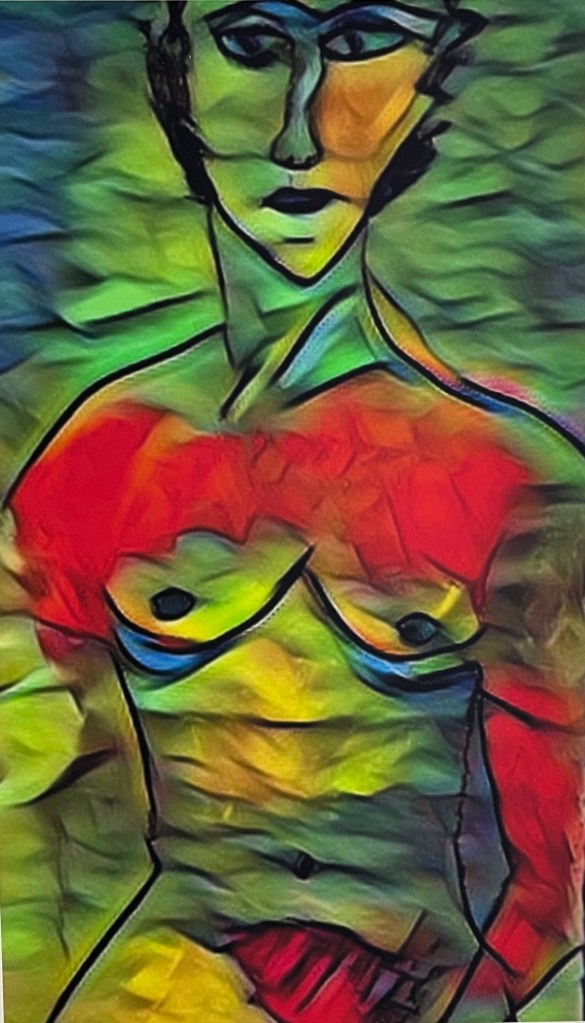
“fire is racing under my skin”
(Sappho, Fragment 31)
These two figures emerge through an artistic process of transformation: first as fragile line drawings on wrinkled rice paper, then as digitally saturated iconography whose chromatic intensity alters but does not erase the original hand.
The movement between the two stages resembles an excavation and reanimation. The first, charcoal drawing on rice paper, appears archaic, tentative, almost commemorative; the second, where a digital overlay is applied, acquires the force of a contemporary icon. Together they form a dialogue between commemoration and iconography
The initial drawing possesses the austerity of archaic representation. The body is frontal and simplified, emotionally direct. Its sparse charcoal contours and the exposed paper produce what Adorno would argue are the aesthetics of truth making. Or what David Hinton would say represent the cosmos, the emptiness and presence.
Sappho, as the title references, survives culturally in these two works as an icon but I wanted to draw the viewer ‘s attention, to the many attempts by the patriarchy to destroy her and her writings, poetry, literature and philosophy. Their attempts to destroy her, silence her, allows us to see her fragility.
The fragile materiality of the drawing echoes this condition. The taped surface and visible creases resemble an excavated relic or deteriorated manuscript, giving the figure the temporal recovered memory.
The later digital overlay intensifies what was latent in the original image. Color becomes structural rather than decorative. Red zones across the breasts and pelvis transform the figure into a site of eros, passion, pain and psychic heat. The greens and blues suggest sea-light, introducing the Mediterranean and archaic associations without literal quotation. The resulting image recalls aspects of Expressionism and early modernist figuration, while still retaining the style of stillness that we understand as archaic Greek forms.
MEANING of these pieces
The original drawing is intimate while the digital intervention produces distance, stylization, and monumentality. Yet the second image depends entirely upon the first. The digital layer does not replace the hand-drawn figure but amplifies its emotional architecture through color. One could say that the process enacts what Theodor Adorno described as the artwork’s simultaneous autonomy and historical embeddedness: the image becomes modern precisely through the persistence of its warned and imperfect substrate. In Aesthetic Theory, Adorno argues that authentic artworks preserve traces of the material as fracture or dissonance, indicating an incomplete and broken world. Here the wrinkles and distortions remain visible beneath the digital color fields.
The figures also participate in what Howard Hinton described, in his writings on East Asian aesthetics and line, as the expressive primacy of contour over illusionistic realism. The drawn line here is not descriptive in an academic sense; it is calligraphic and psychic. The body is constructed through emotional emphasis rather than anatomical fidelity. This gives the figures an archaic authority despite their modern means of production.
Finally, the transformation from the drawing into a digitally painting, is where the work expresses the psychological intensity associated with Hans Hoffman’s theories of expression and pictorial structure: color operates affectively before it operates representationally. The red fields do not simply denote flesh or blood; they generate heat within the composition itself. Thus the title — A fire runs under my skin — becomes not metaphor alone but formal principle. The image appears heated from within.
These works ultimately resist easy identity or classification. They are neither classical revivals nor purely digital constructions. Instead, they occupy an intermediate territory between fragment and icon, memory and invention, bodily vulnerability and ritual permanence. Like Sappho’s surviving verses, the figures attain their force through absence and ambiguity, inviting the viewer into an active process of interpretation.”
References
Aesthetic Theory. Translated by Robert Hullot-Kentor. Minneapolis: University of Minnesota Press, 1997.
Theodor W. Adorno, “On Lyric Poetry and Society,” in Notes to Literature, Volume I. New York: Columbia University Press, 1991.
The Classical World of Sappho. Various editions and fragment numerations consulted for the phrase commonly rendered as “a fire runs under my skin,” associated with Fragment 31 traditions.
Howard Hinton. The Art of Ancient China. Boston: Museum of Fine Arts publications and related essays on line, contour, and expressive form in East Asian art traditions.
Hans Hofmann. Search for the Real and Other Essays. Cambridge, MA: MIT Press, 1948.
The Fragments of Sappho. translations by Anne Carson
Amedeo Modigliani. Comparative visual reference for elongation and hieratic figuration.
 Art by Kate W