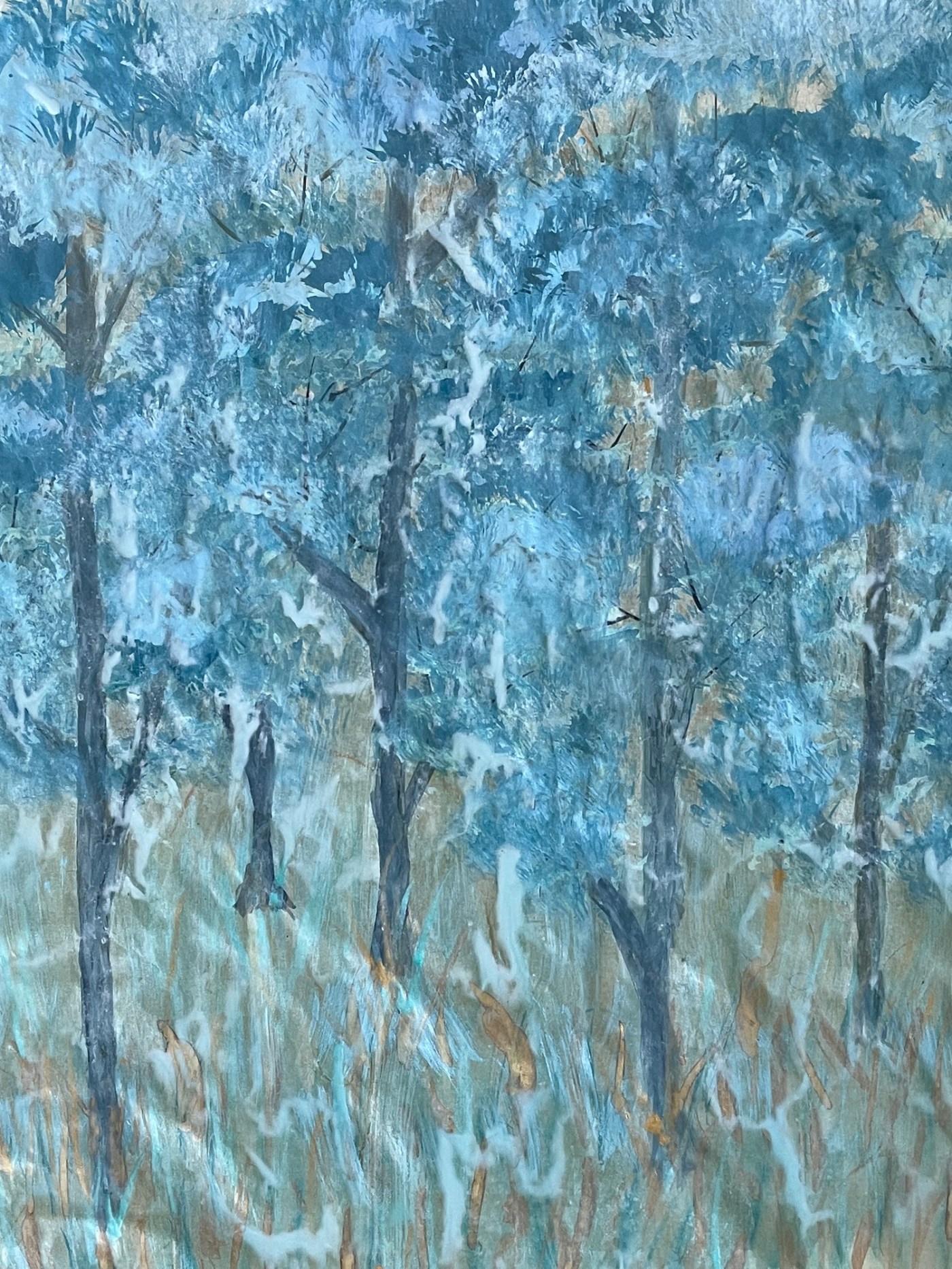
Classical landscape painting often stabilizes perception. It tells us where we are. Classical landscapes include:
foreground
middle ground
background
identifiable objects
coherent space
The world becomes ordered and consumable.
My paintings work differently. The viewer sees dissonance, forms emerging, then dissolving.
The white droplets, drips, veils, and dissolving edges interrupt stable viewing. The eye cannot establish a final hierarchy. Space fluctuates. Forms emerge and sink back. There is more often, not a fixed focal point, rather a relational field.
Adorno would say that the painting enacts a truth about experience itself: The object is more than what our concepts make of it. The instability is therefore not a defect but a revelation.
Where This Meets Hinton’s Tao
This is where Adorno and Hinton unexpectedly overlap with one another.
David Hinton would say: Reality is continuous transformation.
Adorno would say: Reality always exceeds conceptual capture.
Those are not identical claims, but my paintings generate a similar visual experience.
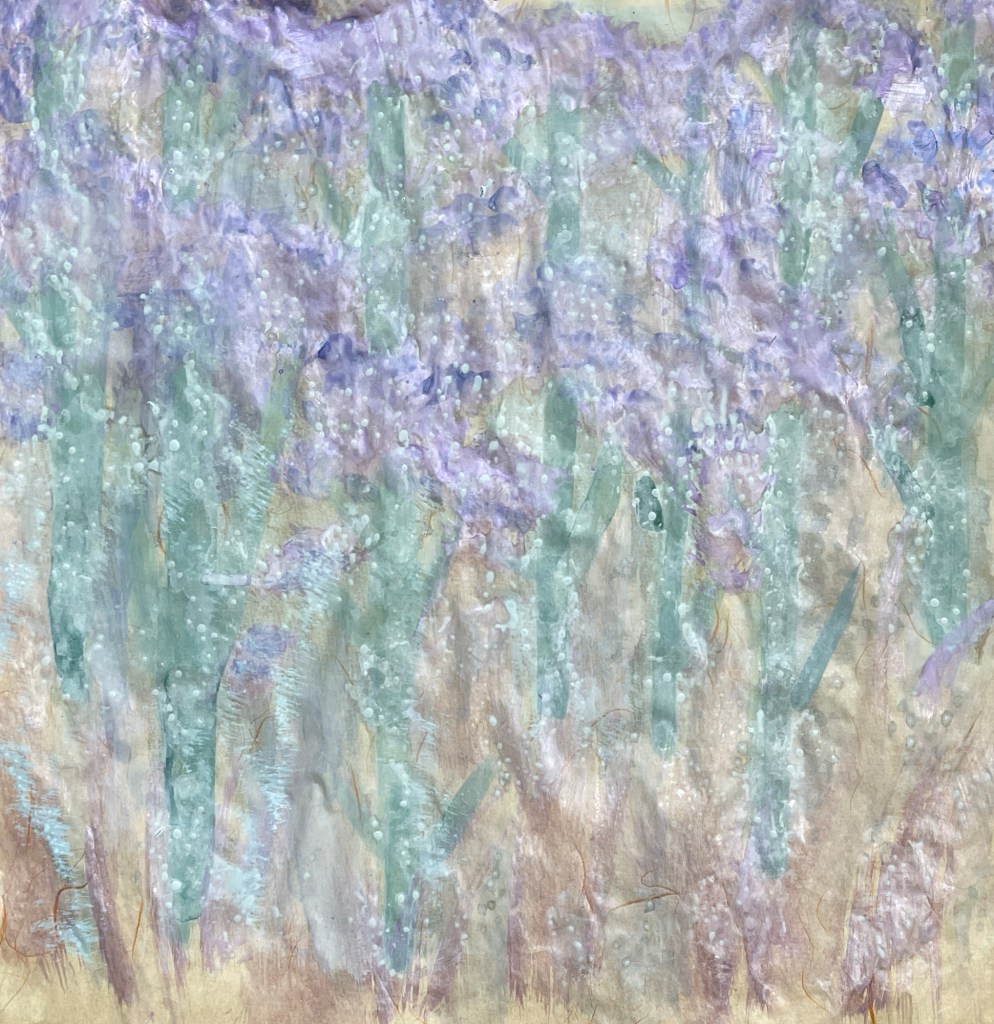
The blossoms are never fully blossoms.
The trees are never fully trees.
The paintings do not depict nature as a collection of finished objects. They depict perception encountering a world that remains partly beyond possession. The paintings present an encounter, an emergence, a threshold to the unfolding.
That encounter—the moment when recognition gives way to uncertainty and then returns again—is what Adorno would call the genuinely aesthetic experience. It is not simply seeing nature. It is experiencing the inadequacy of one’s own categories before nature’s irreducible particularity.


Leave a Reply