Thinking of Klimt
Comparing some recent work with Klimt’s landscapes. (I have for over 50 years, been attracted to Klimt’s portraits and landscapes. I just recently went back to look at his landscapes, and see similarities with my recent mixed media landscapes.)
Seeing two recent landscapes of mine, along with these Klimt pieces, emphasizes that we are both moving toward some of the same structural territory yet, by a very different route.
Klimt’s work is useful as a kind of measuring stick because his surface dissolves the distinction between forest, pattern, atmosphere, and ornament. My work is doing something related. (I continue to hold onto abstraction , as I have been influenced by Adorno, to seek multiplicity and to keep things “unresolved” in my paintings. )
The Klimts
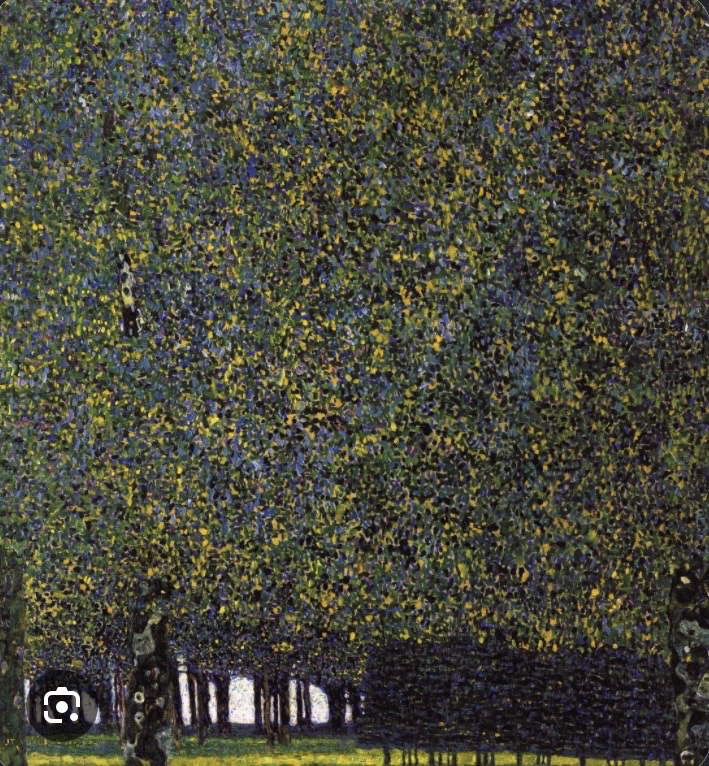
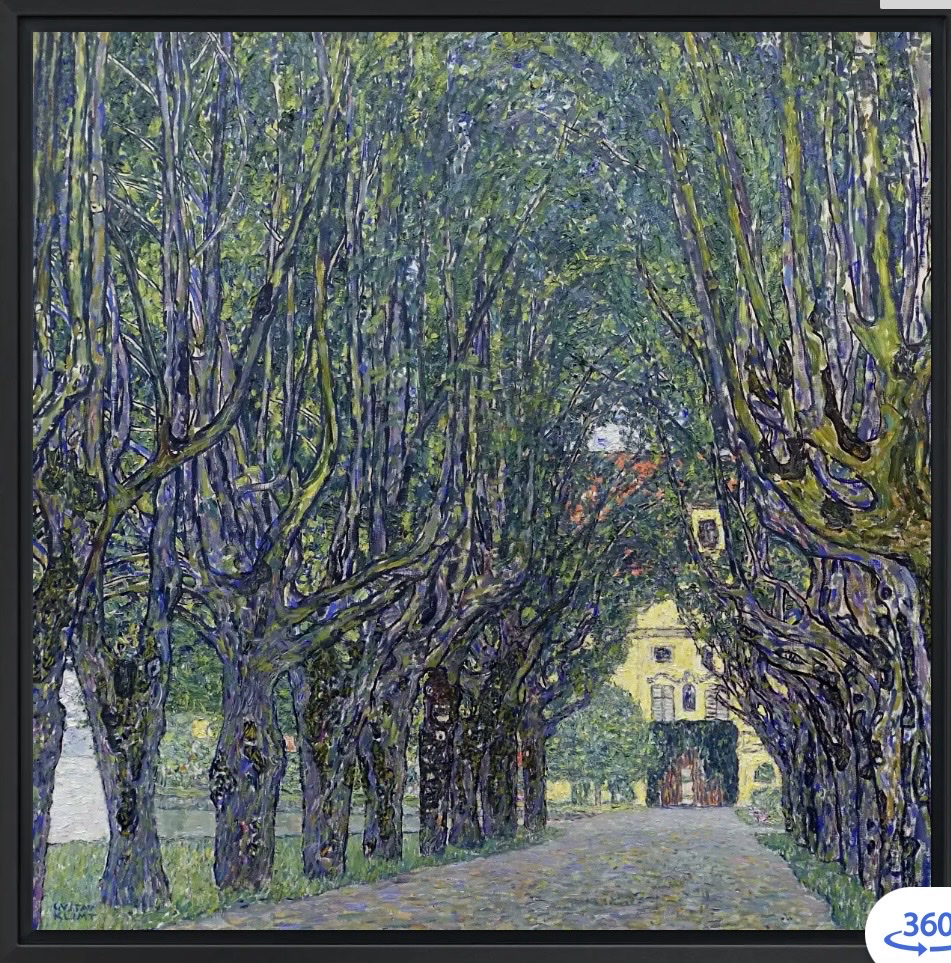
Klimt’s landscapes present an interesting balance between recognizable place and near-total abstraction.
The forest is still there. We can sense trunks, depth, ground, canopy. But Klimt breaks the foliage into thousands of small chromatic events. The eye doesn’t settle on a single leaf or tree. Instead, it oscillates between: trees, patterns, light, patterns, forests.
And importantly, the dark vertical trunks provide just enough structural information to keep the surface from becoming merely decorative.
two pieces
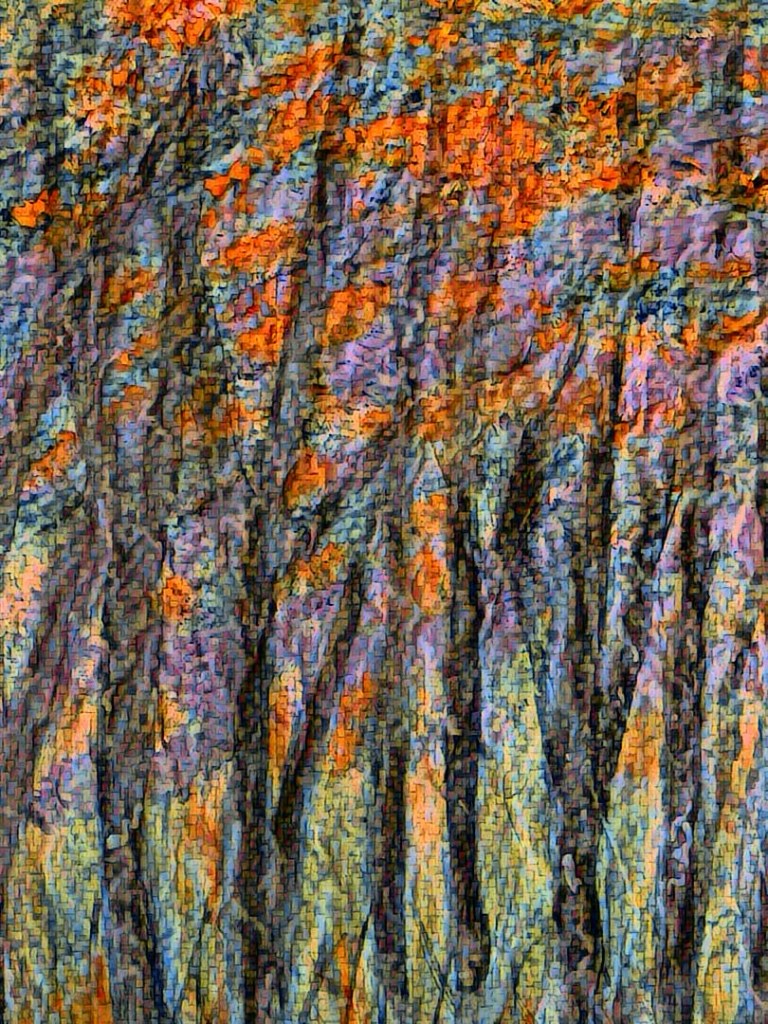
Taking my first piece — the orange/blue vertical forest: Where Klimt’s work pushes the dissolution of the forest and I am pushing it further toward perception itself.
In my recent work, with a digital overlay, little marks create a vibrating field in which the trees emerge and disappear. The vertical trunks are present, and might be considered dominant.
The viewer doesn’t need a clearly drawn tree. A few vertical gestures, a change in density, a chromatic current—and suddenly the mind supplies forest.
The orange, blue, lavender, gray and pale turquoise continually break into one another. The forest seems to be undergoing transformation and unfolding, rather than simply being observed.
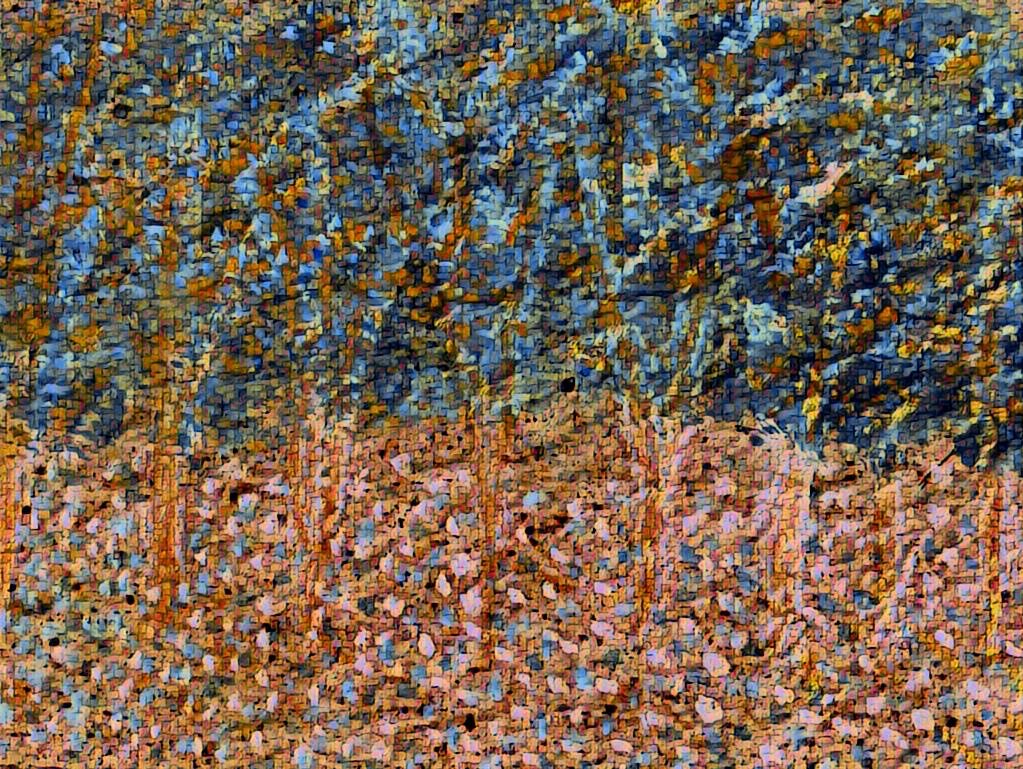
The— blue/yellow/pink—horizontal landscape
There is a suggestion of a horizon or a division between upper and lower worlds, but it isn’t fixed. The blue field could be sky, water, atmosphere, or something entirely internal. The pink/brown lower field could be earth, vegetation, reflected light—or simply another energetic field.
The yellow marks function almost like particles of light.
I’m interested in the idea of energetic fields, where perception is based on distance, eg the painting looks substantially different when viewed upclose compared to seen at a distance.
Additionally while the interstitial pattern provides a uniformity, it continues to make nature seen as uncertain.
Klimt’s question is something like: How can nature become pattern without ceasing to be nature?
And my question is how do patterns of interstitial color markings suggest a field of relationships, much like the cosmos and fields of energy?
The viewer has to cross a threshold to see it.

